Lorenzo Magnani
eBook, PDF
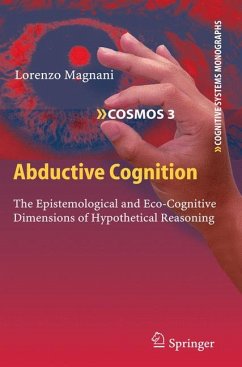
Abductive Cognition (eBook, PDF)
The Epistemological and Eco-Cognitive Dimensions of Hypothetical Reasoning
PAYBACK Punkte
56 °P sammeln!
rational model of discovery is impossible. In short, scienti?c creative inferences are irrational and there is no "reasoning" to hypotheses.
Dieser Download kann aus rechtlichen Gründen nur mit Rechnungsadresse in A, B, BG, CY, CZ, D, DK, EW, E, FIN, F, GR, HR, H, IRL, I, LT, L, LR, M, NL, PL, P, R, S, SLO, SK ausgeliefert werden.
Lorenzo Magnani, philosopher, epistemologist, and cognitive scientist, is a professor of Philosophy of Science at the University of Pavia, Italy, and the director of its Computational Philosophy Laboratory. Authors and editor of many books and proceedings and of about 400 publications in 2015 has been appointed member of the International Academy for the Philosophy of the Sciences (AIPS). He is the editor of the Book Series Studies in Applied Philosophy, Epistemology and Rational Ethics (SAPERE), Springer, Switzerland.
Produktdetails
- Verlag: Springer Berlin Heidelberg
- Seitenzahl: 535
- Erscheinungstermin: 13. Oktober 2009
- Englisch
- ISBN-13: 9783642036316
- Artikelnr.: 37373854
From the reviews:
"Lorenzo Magnani has produced a magnum opus on abduction that brilliantly spans its philosophical, neuropsychological, computational, and ecological dimensions. In this review I will briefly highlight some of the substantial contributions of Abductive Cognition ... . anyone interested in mind and society needs to pay attention to abductive cognition. There is no better place to jump off from than Lorenzo Magnani's new book." (Paul Thagard, Mind & Society, April, 2010)
"The aim of the monograph series is to record new developments in cognitive systems research. ... The appearance of Abductive Cognition is a major event in cognitive science and the philosophy of science. In its reach, complexity and detail,
"Lorenzo Magnani has produced a magnum opus on abduction that brilliantly spans its philosophical, neuropsychological, computational, and ecological dimensions. In this review I will briefly highlight some of the substantial contributions of Abductive Cognition ... . anyone interested in mind and society needs to pay attention to abductive cognition. There is no better place to jump off from than Lorenzo Magnani's new book." (Paul Thagard, Mind & Society, April, 2010)
"The aim of the monograph series is to record new developments in cognitive systems research. ... The appearance of Abductive Cognition is a major event in cognitive science and the philosophy of science. In its reach, complexity and detail,
Mehr anzeigen
it outpaces everything in the field. In its originality and daring, it is the freshest thing around and a tour de force. It is a book to be reckoned with." (John Woods, Studies in History and Philosophy of Science, 2011)
"In Abductive Cognition Magnani pushes further his reflections on abduction ... making of this concept as a key for understanding cognition. ... To demonstrate the way the concept of abduction can be unfolded ... in its many fields of application is the aim of the rest of the book. ... Abductive Cognition does an impressive work in sketching some previously unexplored consequences of the concept of abduction in a cognitive framework ... and in opening new ways of semiotically investigating cognitive phenomena." (Riccardo Fusaroli, Versus, 2010)
"Lorenzo Magnani's new book Abductive Cognition is an important addition ... on the nature of abduction. ... The book is full of ideas and approaches. ... this is an essential reading for all who are interested in abduction, or (distributed) cognition, and especially those who are interested in both of them. Hopefully this is a growing group of people! There is also a large list of references as well as a short vocabulary on abductivecognition at the end of the book." (Sami Paavola, Journal of General Philosophy of Science, March, 2011)
"Magnani's book is an ambitious and ecumenical essay on that phenomenon, an attempt to collect and integrate research, old and new, regarding abductive thinking. ... The audience of this volume is a readership already interested in the subject and acquainted with the basic issues surrounding it. ... this review is to outline the thread of its development for the benefit of a broader audience, and to help readers perceive the overall thrust of the work in the midst of the many details recounted in it." (Cameron Shelley, Minds and Machines, December, 2011)
"In Abductive Cognition Magnani pushes further his reflections on abduction ... making of this concept as a key for understanding cognition. ... To demonstrate the way the concept of abduction can be unfolded ... in its many fields of application is the aim of the rest of the book. ... Abductive Cognition does an impressive work in sketching some previously unexplored consequences of the concept of abduction in a cognitive framework ... and in opening new ways of semiotically investigating cognitive phenomena." (Riccardo Fusaroli, Versus, 2010)
"Lorenzo Magnani's new book Abductive Cognition is an important addition ... on the nature of abduction. ... The book is full of ideas and approaches. ... this is an essential reading for all who are interested in abduction, or (distributed) cognition, and especially those who are interested in both of them. Hopefully this is a growing group of people! There is also a large list of references as well as a short vocabulary on abductivecognition at the end of the book." (Sami Paavola, Journal of General Philosophy of Science, March, 2011)
"Magnani's book is an ambitious and ecumenical essay on that phenomenon, an attempt to collect and integrate research, old and new, regarding abductive thinking. ... The audience of this volume is a readership already interested in the subject and acquainted with the basic issues surrounding it. ... this review is to outline the thread of its development for the benefit of a broader audience, and to help readers perceive the overall thrust of the work in the midst of the many details recounted in it." (Cameron Shelley, Minds and Machines, December, 2011)

Schließen
Für dieses Produkt wurde noch keine Bewertung abgegeben. Wir würden uns sehr freuen, wenn du die erste Bewertung schreibst!
Eine Bewertung schreiben
Andere Kunden interessierten sich für