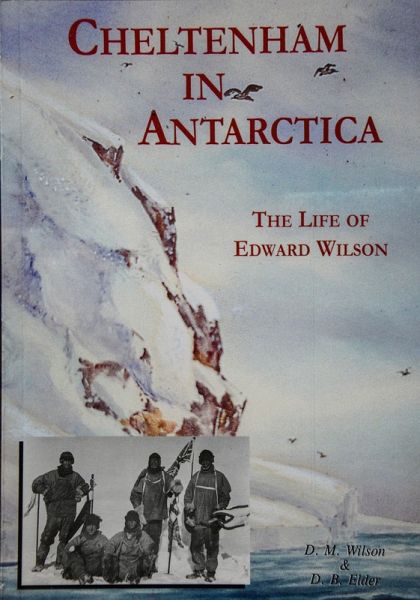
Cheltenham in Antartica (eBook, ePUB)
The Life Of Edward Wilson

PAYBACK Punkte
0 °P sammeln!

Edward Adrian Wilson is perhaps the most famous native son of Cheltenham. Inthe early years of the 20th Century, he was one of the major influences andpersonalities of the heroic age of Antarctic exploration and has also beenrecognised as one of the top ranking ornithologists and naturalists in the UnitedKingdom during this period. He was also one of the last great scientific expeditionartists.Despite this, remarkably little has been published about him. His father wrote anunpublished biography of him shortly after his death. This was an importantsource for George Seaver, who published three v...
Edward Adrian Wilson is perhaps the most famous native son of Cheltenham. In
the early years of the 20th Century, he was one of the major influences and
personalities of the heroic age of Antarctic exploration and has also been
recognised as one of the top ranking ornithologists and naturalists in the United
Kingdom during this period. He was also one of the last great scientific expedition
artists.
Despite this, remarkably little has been published about him. His father wrote an
unpublished biography of him shortly after his death. This was an important
source for George Seaver, who published three volumes of biography on Edward
Wilson in the 1930s and 40s, fortunately quoting extensively from his letters and
diaries. After the appearance of the first two volumes much of the source material
that Seaver had used was destroyed, most of it on the instructions of Oriana,
Edward Wilson's widow. There was nothing malicious in this: she simply thought
that she had done her public duty in allowing a biography to be published and did
not want strangers digging around in her private correspondence after her death.
In the 1960s and 70s, through the Scott Polar Research Institute, the Antarctic
expedition diaries of Edward Wilson and a volume of his Antarctic bird pictures
were published. Several people tried to write new biographies in the 1970s and
80s but all failed for the lack of new material: due to the subsequent events,
George Seaver's books and the published diaries already contained much of the
source material about the life of Edward Wilson.
As such this volume draws heavily on the work of Edward Wilson's father, on the
published diaries, and on George Seaver. With Seaver in particular, however, his
use of the historical sources available to him requires a word of caution: he
frequently used the narrative technique of rolling quotations from several letters or
diary entries into one quotation, passing them off as a single quotation from a
single document. Since he published no footnotes it is almost impossible to
establish where he has or has not done this, although his longer quotations, or
quotations from complete letters, tend to be accurate. Unlike some commentators
in subsequent generations, who often use quotation techniques to alter historical
facts and to mis-represent what was said, with Seaver it is generally benign - he
has not, as far as we have discovered, changed the sense of meaning, or misrepresented
facts external to the actual form of the quotation. It is, however,
something of a disaster from the point of view of accurate scholarship given that
the original manuscripts are often no longer available. We have done our best,
where possible, to find the original sources but these are very scattered, where
they still exist, and it is painstaking work. Occasionally, they can be recreated
through bringing together copied extracts - fortunately a habit in which many of
the Wilson family indulged - such as in Edward Wilson's last letter to Oriana,
reproduced towards the end of this book.
In many ways, therefore, the following text should not be seen as a major new
biography of Edward Wilson but rather as a complement to the volumes of
George Seaver. This is not to say that there is no new material in the book, there
should be enough to interest polar scholars, though there may not be as much as
they had hoped. Where possible, we have also chosen to use previously
unpublished illustrations from the vast collections of Edward Wilson's pictures.
These, alone, should be enough to interest those in search of new material. Our
aim, however, is to meet the many hundreds of enquiries received about this
famous son of Cheltenham and his life. Edward Wilson is one of the most asked
after aspects of the collections at the Cheltenham Art Gallery and Museums. This
work is intended to answer this demand from the public for something about
Edward Wilson to be available to them in print, and to identify the 'Wilson sites' in
and around Cheltenham, rather than to write an academic book. As such there are
no footnotes but an annotated copy of the text will be placed in the collections of
the Scott Polar Research Institute, the Cheltenham Public Library and the
Cheltenham Museum, so that those who may be interested in the historical
sources for this work will be able to find them.
Finally, it seems impossible not to say a few words about the contemporary
situation as regards polar historical scholarship and biography, against which this
book will inevitably be judged by some. We hope that this work is an exception to
the current fashion for cynicism. Some will doubtless find it an "old fashioned" or
"non-critical" work as a result. For this we make no apology. Our aim isn't to pick
for faults like vultures at a carcass, nor to sit in judgement, but to help you to get to
know a remarkably complex man a little better - and maybe - just maybe - you
will find a little inspiration for your own life and times through the life and times of
Edward Adrian Wilson.
the early years of the 20th Century, he was one of the major influences and
personalities of the heroic age of Antarctic exploration and has also been
recognised as one of the top ranking ornithologists and naturalists in the United
Kingdom during this period. He was also one of the last great scientific expedition
artists.
Despite this, remarkably little has been published about him. His father wrote an
unpublished biography of him shortly after his death. This was an important
source for George Seaver, who published three volumes of biography on Edward
Wilson in the 1930s and 40s, fortunately quoting extensively from his letters and
diaries. After the appearance of the first two volumes much of the source material
that Seaver had used was destroyed, most of it on the instructions of Oriana,
Edward Wilson's widow. There was nothing malicious in this: she simply thought
that she had done her public duty in allowing a biography to be published and did
not want strangers digging around in her private correspondence after her death.
In the 1960s and 70s, through the Scott Polar Research Institute, the Antarctic
expedition diaries of Edward Wilson and a volume of his Antarctic bird pictures
were published. Several people tried to write new biographies in the 1970s and
80s but all failed for the lack of new material: due to the subsequent events,
George Seaver's books and the published diaries already contained much of the
source material about the life of Edward Wilson.
As such this volume draws heavily on the work of Edward Wilson's father, on the
published diaries, and on George Seaver. With Seaver in particular, however, his
use of the historical sources available to him requires a word of caution: he
frequently used the narrative technique of rolling quotations from several letters or
diary entries into one quotation, passing them off as a single quotation from a
single document. Since he published no footnotes it is almost impossible to
establish where he has or has not done this, although his longer quotations, or
quotations from complete letters, tend to be accurate. Unlike some commentators
in subsequent generations, who often use quotation techniques to alter historical
facts and to mis-represent what was said, with Seaver it is generally benign - he
has not, as far as we have discovered, changed the sense of meaning, or misrepresented
facts external to the actual form of the quotation. It is, however,
something of a disaster from the point of view of accurate scholarship given that
the original manuscripts are often no longer available. We have done our best,
where possible, to find the original sources but these are very scattered, where
they still exist, and it is painstaking work. Occasionally, they can be recreated
through bringing together copied extracts - fortunately a habit in which many of
the Wilson family indulged - such as in Edward Wilson's last letter to Oriana,
reproduced towards the end of this book.
In many ways, therefore, the following text should not be seen as a major new
biography of Edward Wilson but rather as a complement to the volumes of
George Seaver. This is not to say that there is no new material in the book, there
should be enough to interest polar scholars, though there may not be as much as
they had hoped. Where possible, we have also chosen to use previously
unpublished illustrations from the vast collections of Edward Wilson's pictures.
These, alone, should be enough to interest those in search of new material. Our
aim, however, is to meet the many hundreds of enquiries received about this
famous son of Cheltenham and his life. Edward Wilson is one of the most asked
after aspects of the collections at the Cheltenham Art Gallery and Museums. This
work is intended to answer this demand from the public for something about
Edward Wilson to be available to them in print, and to identify the 'Wilson sites' in
and around Cheltenham, rather than to write an academic book. As such there are
no footnotes but an annotated copy of the text will be placed in the collections of
the Scott Polar Research Institute, the Cheltenham Public Library and the
Cheltenham Museum, so that those who may be interested in the historical
sources for this work will be able to find them.
Finally, it seems impossible not to say a few words about the contemporary
situation as regards polar historical scholarship and biography, against which this
book will inevitably be judged by some. We hope that this work is an exception to
the current fashion for cynicism. Some will doubtless find it an "old fashioned" or
"non-critical" work as a result. For this we make no apology. Our aim isn't to pick
for faults like vultures at a carcass, nor to sit in judgement, but to help you to get to
know a remarkably complex man a little better - and maybe - just maybe - you
will find a little inspiration for your own life and times through the life and times of
Edward Adrian Wilson.
Dieser Download kann aus rechtlichen Gründen nur mit Rechnungsadresse in A, B, BG, CY, CZ, D, DK, EW, E, FIN, F, GR, H, IRL, I, LT, L, LR, M, NL, PL, P, R, S, SLO, SK ausgeliefert werden.
Andere Kunden interessierten sich für