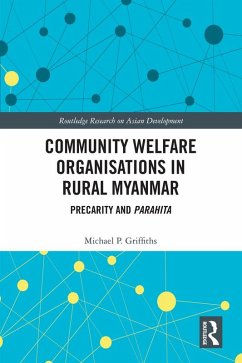
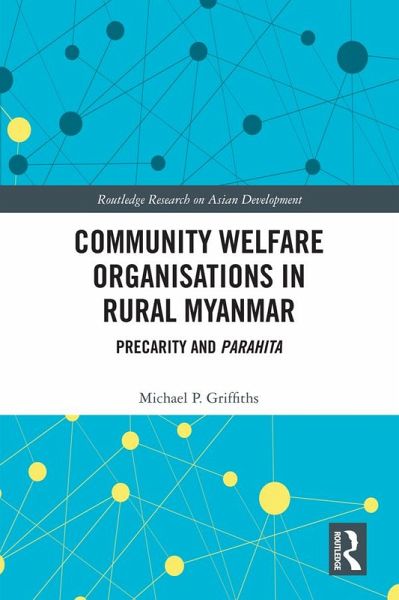
Community Welfare Organisations in Rural Myanmar (eBook, ePUB)
Precarity and Parahita
Versandkostenfrei!
Sofort per Download lieferbar
41,95 €
inkl. MwSt.
Weitere Ausgaben:

PAYBACK Punkte
21 °P sammeln!

This book provides an in-depth study of the moral economies emerging from within conditions of precarity in rural communities in contemporary Myanmar.James C. Scott's seminal work on 'The Moral Economy of the Peasant' argued that peasant notions of subsistence and expectations of reciprocity formed the basis for subsequent rebellion as economic conditions changed and new market forces were introduced. Now, nearly a century on, Michael Griffiths argues that the conditions faced by rural communities in Myanmar remain precarious, but different forms of moral economy shape their responses. In the ...
This book provides an in-depth study of the moral economies emerging from within conditions of precarity in rural communities in contemporary Myanmar.
James C. Scott's seminal work on 'The Moral Economy of the Peasant' argued that peasant notions of subsistence and expectations of reciprocity formed the basis for subsequent rebellion as economic conditions changed and new market forces were introduced. Now, nearly a century on, Michael Griffiths argues that the conditions faced by rural communities in Myanmar remain precarious, but different forms of moral economy shape their responses. In the contemporary context, the moral economy of rural communities is characterized by the emergence of localized, self-organized community welfare associations which adopt a sophisticated iteration of self-help framed by the Buddhist concept of parahita (altruism). This book analyses the performative nature of these welfare organizations as a form of politics, asking how notions of citizenship expressed in these organizations promote more inclusive, or more exclusive practices towards non-Buddhist minorities.
At a time when discourse on identity in Myanmar has been dominated by practices of othering and exclusion, this book provides an important analysis of what citizenship and reciprocity means in contemporary rural Myanmar. This book is a critical resource for researchers working on rural development and the social sciences in Southeast Asia.
James C. Scott's seminal work on 'The Moral Economy of the Peasant' argued that peasant notions of subsistence and expectations of reciprocity formed the basis for subsequent rebellion as economic conditions changed and new market forces were introduced. Now, nearly a century on, Michael Griffiths argues that the conditions faced by rural communities in Myanmar remain precarious, but different forms of moral economy shape their responses. In the contemporary context, the moral economy of rural communities is characterized by the emergence of localized, self-organized community welfare associations which adopt a sophisticated iteration of self-help framed by the Buddhist concept of parahita (altruism). This book analyses the performative nature of these welfare organizations as a form of politics, asking how notions of citizenship expressed in these organizations promote more inclusive, or more exclusive practices towards non-Buddhist minorities.
At a time when discourse on identity in Myanmar has been dominated by practices of othering and exclusion, this book provides an important analysis of what citizenship and reciprocity means in contemporary rural Myanmar. This book is a critical resource for researchers working on rural development and the social sciences in Southeast Asia.
Dieser Download kann aus rechtlichen Gründen nur mit Rechnungsadresse in A, B, BG, CY, CZ, D, DK, EW, E, FIN, F, GR, HR, H, IRL, I, LT, L, LR, M, NL, PL, P, R, S, SLO, SK ausgeliefert werden.
Andere Kunden interessierten sich für