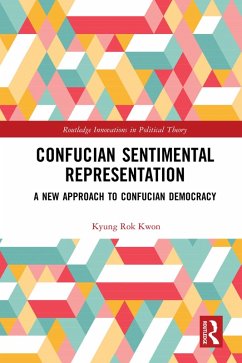
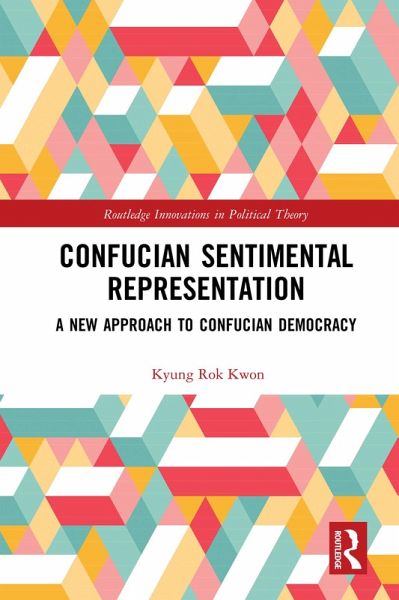
Confucian Sentimental Representation (eBook, PDF)
A New Approach to Confucian Democracy
Versandkostenfrei!
Sofort per Download lieferbar
41,95 €
inkl. MwSt.
Weitere Ausgaben:

PAYBACK Punkte
21 °P sammeln!

Kwon conceptualizes a unique mode of political representation in East Asian society, which derives its moral foundation from Confucian virtue politics.Contemporary East Asian societies understand democracy differently than Western societies do. Even citizens in consolidated democracies such as Taiwan and South Korea have different conceptions of an ideal relationship between a political leader and ordinary citizens, as well as a political leader's accountability and political legitimacy. A political leader's proper conduct, including his or her everyday languages, behaviors, and expressions wh...
Kwon conceptualizes a unique mode of political representation in East Asian society, which derives its moral foundation from Confucian virtue politics.
Contemporary East Asian societies understand democracy differently than Western societies do. Even citizens in consolidated democracies such as Taiwan and South Korea have different conceptions of an ideal relationship between a political leader and ordinary citizens, as well as a political leader's accountability and political legitimacy. A political leader's proper conduct, including his or her everyday languages, behaviors, and expressions when facing citizens' sorrow, anger, and resentment, plays a crucial role in evaluating whether he or she has political legitimacy in East Asian society. Kwon analyses how this "affective accountability" forms the basis for political representation in these societies and examines how this can be reconciled with liberal democracy.
A vital contribution not only to Confucian political theory, but also to political theory writ large that will be of especial value to political scientists with an interest in East Asian democracy.
Contemporary East Asian societies understand democracy differently than Western societies do. Even citizens in consolidated democracies such as Taiwan and South Korea have different conceptions of an ideal relationship between a political leader and ordinary citizens, as well as a political leader's accountability and political legitimacy. A political leader's proper conduct, including his or her everyday languages, behaviors, and expressions when facing citizens' sorrow, anger, and resentment, plays a crucial role in evaluating whether he or she has political legitimacy in East Asian society. Kwon analyses how this "affective accountability" forms the basis for political representation in these societies and examines how this can be reconciled with liberal democracy.
A vital contribution not only to Confucian political theory, but also to political theory writ large that will be of especial value to political scientists with an interest in East Asian democracy.
Dieser Download kann aus rechtlichen Gründen nur mit Rechnungsadresse in A, B, BG, CY, CZ, D, DK, EW, E, FIN, F, GR, HR, H, IRL, I, LT, L, LR, M, NL, PL, P, R, S, SLO, SK ausgeliefert werden.
Andere Kunden interessierten sich für