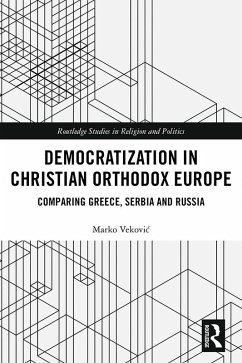
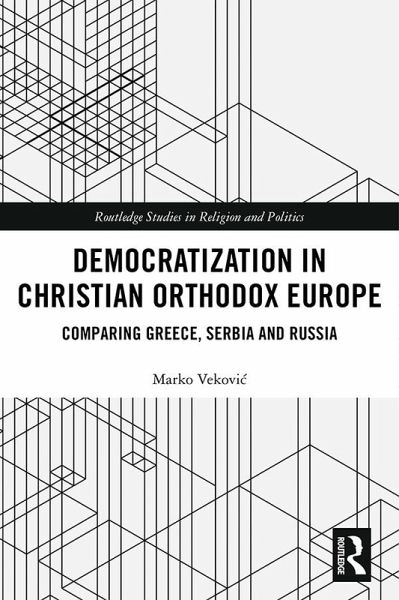
Democratization in Christian Orthodox Europe (eBook, PDF)
Comparing Greece, Serbia and Russia
Versandkostenfrei!
Sofort per Download lieferbar
41,95 €
inkl. MwSt.
Weitere Ausgaben:

PAYBACK Punkte
21 °P sammeln!

For a long time, Orthodox Christianity was regarded as a religious tradition that was incompatible with democracy. This book challenges this incompatibility thesis, offering an innovative and fresh theoretical framework for dealing with the issue of Orthodoxy and democracy.This book focuses on the political behaviour of Orthodox Christian Churches in the democratization processes from a comparative perspective, and shows that different Orthodox Churches acted differently in the democratization processes in Greece, Serbia and Russia. The fundamental question that arises is - why? By focusing on...
For a long time, Orthodox Christianity was regarded as a religious tradition that was incompatible with democracy. This book challenges this incompatibility thesis, offering an innovative and fresh theoretical framework for dealing with the issue of Orthodoxy and democracy.
This book focuses on the political behaviour of Orthodox Christian Churches in the democratization processes from a comparative perspective, and shows that different Orthodox Churches acted differently in the democratization processes in Greece, Serbia and Russia. The fundamental question that arises is - why? By focusing on institutions, rather than on political theology, this book answers this question from a comparative perspective. By studying the historical, cultural, and political roles of the Orthodox Christian Church in these three countries, the author examines whether it is logical to presume that the Church played a significant role in the democratization process.
This book will be of great interest to academics and students globally who teach, study, and research in the emerging field of religion and democracy.
This book focuses on the political behaviour of Orthodox Christian Churches in the democratization processes from a comparative perspective, and shows that different Orthodox Churches acted differently in the democratization processes in Greece, Serbia and Russia. The fundamental question that arises is - why? By focusing on institutions, rather than on political theology, this book answers this question from a comparative perspective. By studying the historical, cultural, and political roles of the Orthodox Christian Church in these three countries, the author examines whether it is logical to presume that the Church played a significant role in the democratization process.
This book will be of great interest to academics and students globally who teach, study, and research in the emerging field of religion and democracy.
Dieser Download kann aus rechtlichen Gründen nur mit Rechnungsadresse in A, B, BG, CY, CZ, D, DK, EW, E, FIN, F, GR, HR, H, IRL, I, LT, L, LR, M, NL, PL, P, R, S, SLO, SK ausgeliefert werden.
Andere Kunden interessierten sich für