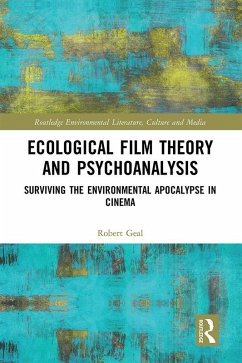
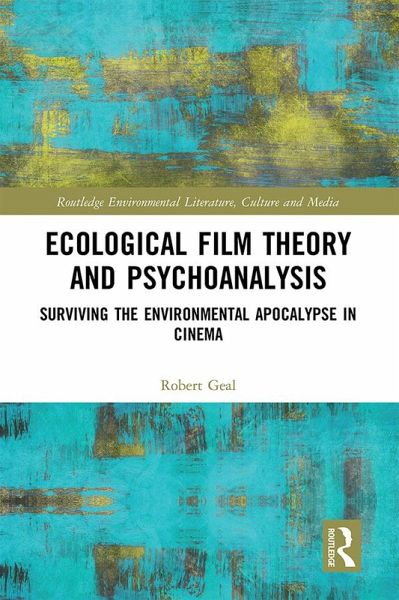
Ecological Film Theory and Psychoanalysis (eBook, PDF)
Surviving the Environmental Apocalypse in Cinema
Versandkostenfrei!
Sofort per Download lieferbar
41,95 €
inkl. MwSt.
Weitere Ausgaben:

PAYBACK Punkte
21 °P sammeln!

This book applies ecolinguistics and psychoanalysis to explore how films fictionalising environmental disasters provide spectacular warnings against the dangers of environmental apocalypse, while highlighting that even these apparently environmentally friendly films can still facilitate problematic real-world changes in how people treat the environment.Ecological Film Theory and Psychoanalysis argues that these films exploit cinema's inherent Cartesian grammar to construct texts in which not only small groups of protagonist survivors, but also vicarious spectators, pleasurably transcend the fi...
This book applies ecolinguistics and psychoanalysis to explore how films fictionalising environmental disasters provide spectacular warnings against the dangers of environmental apocalypse, while highlighting that even these apparently environmentally friendly films can still facilitate problematic real-world changes in how people treat the environment.
Ecological Film Theory and Psychoanalysis argues that these films exploit cinema's inherent Cartesian grammar to construct texts in which not only small groups of protagonist survivors, but also vicarious spectators, pleasurably transcend the fictionalised destruction. The ideological nature of the 'lifeboats' on which these survivors escape, moreover, is accompanied by additional elements that constitute contemporary Cartesian subjectivity, such as class and gender binaries, restored nuclear families, individual as opposed to social responsibilities for disasters, and so on. The book conducts extensive analyses of these processes, before considering alternative forms of filmmaking that might avoid the dangers of this existing form of storytelling. The book's new ecosophy and film theory establishes that Cartesian subjectivity is an environmentally destructive 'symptom' that everyday linguistic activities like watching films reinforce.
This book will be of great interest to students and scholars of film studies, literary studies (specifically ecocriticism), cultural studies, ecolinguistics, and ecosophy.
Ecological Film Theory and Psychoanalysis argues that these films exploit cinema's inherent Cartesian grammar to construct texts in which not only small groups of protagonist survivors, but also vicarious spectators, pleasurably transcend the fictionalised destruction. The ideological nature of the 'lifeboats' on which these survivors escape, moreover, is accompanied by additional elements that constitute contemporary Cartesian subjectivity, such as class and gender binaries, restored nuclear families, individual as opposed to social responsibilities for disasters, and so on. The book conducts extensive analyses of these processes, before considering alternative forms of filmmaking that might avoid the dangers of this existing form of storytelling. The book's new ecosophy and film theory establishes that Cartesian subjectivity is an environmentally destructive 'symptom' that everyday linguistic activities like watching films reinforce.
This book will be of great interest to students and scholars of film studies, literary studies (specifically ecocriticism), cultural studies, ecolinguistics, and ecosophy.
Dieser Download kann aus rechtlichen Gründen nur mit Rechnungsadresse in A, B, BG, CY, CZ, D, DK, EW, E, FIN, F, GR, HR, H, IRL, I, LT, L, LR, M, NL, PL, P, R, S, SLO, SK ausgeliefert werden.
Andere Kunden interessierten sich für