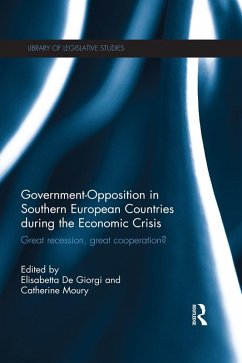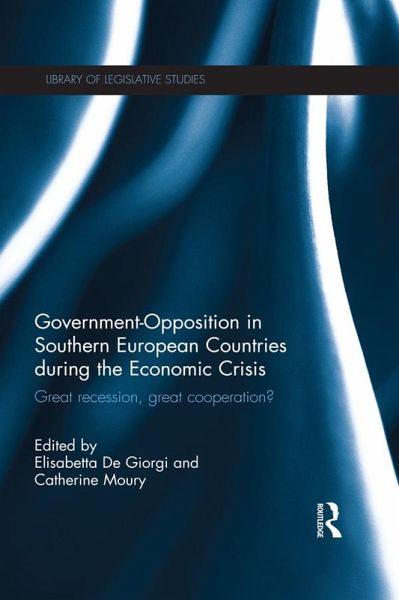
Government-Opposition in Southern European Countries during the Economic Crisis (eBook, ePUB)
Great Recession, Great Cooperation?
Redaktion: Giorgi, Elisabetta; Moury, Catherine
Versandkostenfrei!
Sofort per Download lieferbar
49,95 €
inkl. MwSt.
Weitere Ausgaben:

PAYBACK Punkte
25 °P sammeln!

As a result of the financial crisis, opposition parties have had to choose between the need to cooperate with the majority in order to contribute to necessary socio-economic changes, and the opportunity to stress their adversarial position vis-à-vis governments taking radical and unpopular measures.This book examines how opposition parties address this dilemma. It relies on a qualitative and quantitative analysis of the behaviour of the opposition parties in parliament, in light of the socio-economic issues that have arisen in recent years. It focuses in particular on the impact that the econ...
As a result of the financial crisis, opposition parties have had to choose between the need to cooperate with the majority in order to contribute to necessary socio-economic changes, and the opportunity to stress their adversarial position vis-à-vis governments taking radical and unpopular measures.
This book examines how opposition parties address this dilemma. It relies on a qualitative and quantitative analysis of the behaviour of the opposition parties in parliament, in light of the socio-economic issues that have arisen in recent years. It focuses in particular on the impact that the economic malaise has had on the government-opposition dynamics in the four southern European democracies most acutely hit by the crisis: Greece, Italy, Portugal and Spain, as well as in the European Parliament. Each chapter utilizes a combination of empirical data analysis and qualitative process-tracking to understand the opposition parties' complicated choice between supporting and dissenting.
This book was originally published as a special issue of the Journal of Legislative Studies.
This book examines how opposition parties address this dilemma. It relies on a qualitative and quantitative analysis of the behaviour of the opposition parties in parliament, in light of the socio-economic issues that have arisen in recent years. It focuses in particular on the impact that the economic malaise has had on the government-opposition dynamics in the four southern European democracies most acutely hit by the crisis: Greece, Italy, Portugal and Spain, as well as in the European Parliament. Each chapter utilizes a combination of empirical data analysis and qualitative process-tracking to understand the opposition parties' complicated choice between supporting and dissenting.
This book was originally published as a special issue of the Journal of Legislative Studies.
Dieser Download kann aus rechtlichen Gründen nur mit Rechnungsadresse in A, B, BG, CY, CZ, D, DK, EW, E, FIN, F, GR, HR, H, IRL, I, LT, L, LR, M, NL, PL, P, R, S, SLO, SK ausgeliefert werden.
Andere Kunden interessierten sich für