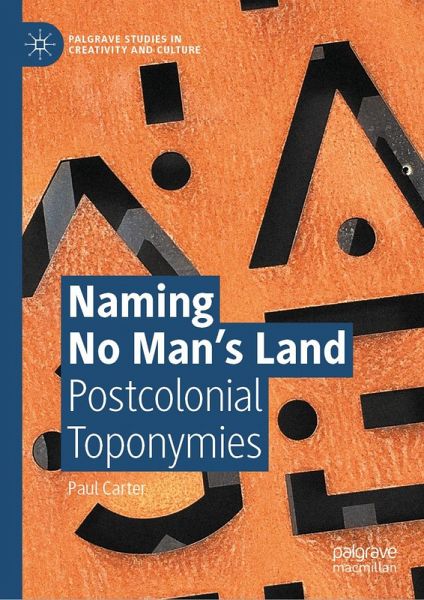
Naming No Man's Land (eBook, PDF)
Postcolonial Toponymies
Versandkostenfrei!
Sofort per Download lieferbar
104,95 €
inkl. MwSt.
Weitere Ausgaben:

PAYBACK Punkte
52 °P sammeln!

This book is a practice-based exploration of the politics and poetics of replacing colonial placenames with Indigenous ones. From a horizon of case-studies in Western Australia, the study develops a lively dialogue with international critical toponymy theory and with older etymological approaches to place renaming and legitimation. The author shows how renaming raises fundamental questions of meaning, reference and cross-cultural equivalence.Recognising the 'sense of place' values that accrue to placenames, Carter argues that placenames have a creative as well as discursive function: they are ...
This book is a practice-based exploration of the politics and poetics of replacing colonial placenames with Indigenous ones. From a horizon of case-studies in Western Australia, the study develops a lively dialogue with international critical toponymy theory and with older etymological approaches to place renaming and legitimation. The author shows how renaming raises fundamental questions of meaning, reference and cross-cultural equivalence.
Recognising the 'sense of place' values that accrue to placenames, Carter argues that placenames have a creative as well as discursive function: they are talking points that bring places into being. For this reason, to decolonize toponymy involves a postcolonial poetics. Naming No Man's Land argues for a practical, community-shaped toponymic poetics that escapes from the binarist logic of imposition/erasure, showing that, when the principle that 'places are made after their stories' is followed, new creative mechanisms of co-existence can emerge. A must read for anyone engaged in postcolonial studies, creativity studies, cultural geography, sociolinguistics, historical ethnography, eco-criticism, environmental humanities, (Australian) Aboriginal studies, and related disciplines.
Recognising the 'sense of place' values that accrue to placenames, Carter argues that placenames have a creative as well as discursive function: they are talking points that bring places into being. For this reason, to decolonize toponymy involves a postcolonial poetics. Naming No Man's Land argues for a practical, community-shaped toponymic poetics that escapes from the binarist logic of imposition/erasure, showing that, when the principle that 'places are made after their stories' is followed, new creative mechanisms of co-existence can emerge. A must read for anyone engaged in postcolonial studies, creativity studies, cultural geography, sociolinguistics, historical ethnography, eco-criticism, environmental humanities, (Australian) Aboriginal studies, and related disciplines.
Dieser Download kann aus rechtlichen Gründen nur mit Rechnungsadresse in A, B, BG, CY, CZ, D, DK, EW, E, FIN, F, GR, HR, H, IRL, I, LT, L, LR, M, NL, PL, P, R, S, SLO, SK ausgeliefert werden.
Andere Kunden interessierten sich für