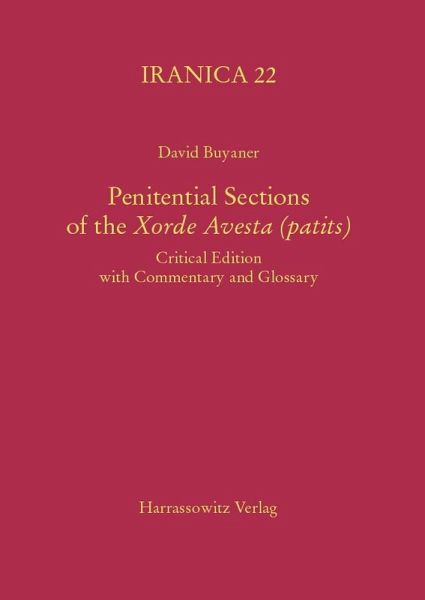
Penitential Sections of the Xorde Avesta (patits) (eBook, PDF)
Critical Edition with Commentary and Glossary
Versandkostenfrei!
Sofort per Download lieferbar
Statt: 98,00 €**
63,95 €
inkl. MwSt.
**Preis der gedruckten Ausgabe (Buch mit Leinen-Einband)
Alle Infos zum eBook verschenken

PAYBACK Punkte
32 °P sammeln!

The Zand ¿ Xorde Awest¿, the Pahlavi version of the compilation of Avestan liturgical texts with the traditional name "Small Avesta" (Xorde Awest¿), is one of the main monuments of the corpus of Pahlavi translations and commentaries (called zand) of Avestan original texts. Since the Xorde Awest¿ and its Pahlavi version consist of a variety of heterogeneous texts which belong to different strata of Zoroastrian literature, they are not only sources of utmost importance for Avestan and Pahlavi philology, but also for the history of Zoroastrianism, and, especially in its penitential sections, ...
The Zand ¿ Xorde Awest¿, the Pahlavi version of the compilation of Avestan liturgical texts with the traditional name "Small Avesta" (Xorde Awest¿), is one of the main monuments of the corpus of Pahlavi translations and commentaries (called zand) of Avestan original texts. Since the Xorde Awest¿ and its Pahlavi version consist of a variety of heterogeneous texts which belong to different strata of Zoroastrian literature, they are not only sources of utmost importance for Avestan and Pahlavi philology, but also for the history of Zoroastrianism, and, especially in its penitential sections, for the reconstruction of Zoroastrian law. The recitals of repentance called Pad¿d ¿ paš¿m¿n¿h ("Penitentiary prayer for repentance", in two versions) and Xwad pad¿d ("Penitentiary prayer for oneself"), which are the main focus of this project, are of great interest for the reconstruction of Zoroastrian jurisprudence, since they contain the most extensive enumeration of sins and offences, using the specific terminology of religious and criminal law. The semantic and etymological analysis of legal vocabulary is one of the most urgent desiderata of Iranian Studies. Two other significant problems in this context concern the date of the composition of the Xorde Awest¿ and the underlying principle of its compilation. An exact analysis of those sections of the Zand ¿ Xorde Awest¿ without a prototype in the Avestan original, such as the Pad¿d texts, which are also known in their P¿zand version (i.e. in Middle Persian written in the Avestan script), would shed light on the question as to why these compositions were included in a zand compilation and the problem of the origins of this unique source.
Dieser Download kann aus rechtlichen Gründen nur mit Rechnungsadresse in A, B, BG, CY, CZ, D, DK, EW, E, FIN, F, GR, HR, H, IRL, I, LT, L, LR, M, NL, PL, P, R, S, SLO, SK ausgeliefert werden.
Andere Kunden interessierten sich für