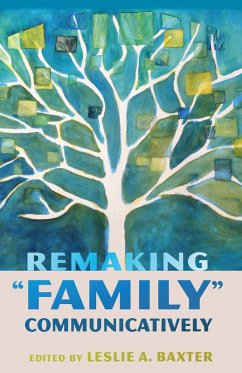
Remaking "Family" Communicatively (eBook, ePUB)
Versandkostenfrei!
Sofort per Download lieferbar
Statt: 47,05 €**
40,95 €
inkl. MwSt.
**Preis der gedruckten Ausgabe (Broschiertes Buch)
Alle Infos zum eBook verschenkenWeitere Ausgaben:

PAYBACK Punkte
20 °P sammeln!

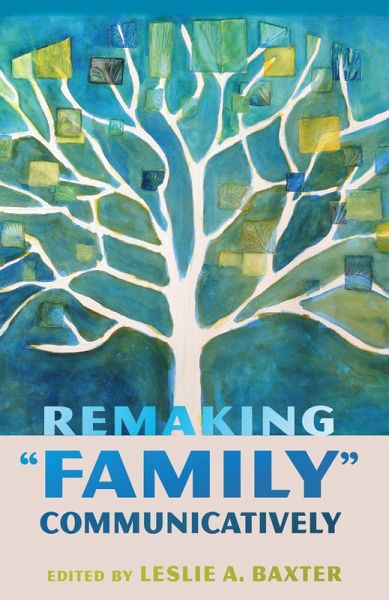
Demographers have repeatedly confirmed that the nuclear family is on the decline. Yet when Americans are asked about their ideal family, the nuclear family emerges as the most valued kind of family. Members of families that do not match this cultural ideal face a discursive burden to legitimate their identity as a «family.» This volume gathers together communication scholars who are working on the many kinds of alternative family forms, from, among others, grandfamilies, diasporic immigrant families, and military families to in (voluntarily) childless families and stepfamilies. The organizin...
Demographers have repeatedly confirmed that the nuclear family is on the decline. Yet when Americans are asked about their ideal family, the nuclear family emerges as the most valued kind of family. Members of families that do not match this cultural ideal face a discursive burden to legitimate their identity as a «family.»
This volume gathers together communication scholars who are working on the many kinds of alternative family forms, from, among others, grandfamilies, diasporic immigrant families, and military families to in (voluntarily) childless families and stepfamilies.
The organizing question for the volume focuses on resistance, reconstruction, and resilience: how is it that alternatives to the traditional family are constructed and sustained through communicative practices? Several chapters adopt a global perspective, thereby framing the issue of legitimation of «family» in a broader cultural context.
None of the family forms described in this volume meets the ideological «gold standard" of the nuclear family, and in this sense they all represent a remaking of the family in profound ways.
This volume gathers together communication scholars who are working on the many kinds of alternative family forms, from, among others, grandfamilies, diasporic immigrant families, and military families to in (voluntarily) childless families and stepfamilies.
The organizing question for the volume focuses on resistance, reconstruction, and resilience: how is it that alternatives to the traditional family are constructed and sustained through communicative practices? Several chapters adopt a global perspective, thereby framing the issue of legitimation of «family» in a broader cultural context.
None of the family forms described in this volume meets the ideological «gold standard" of the nuclear family, and in this sense they all represent a remaking of the family in profound ways.
Dieser Download kann aus rechtlichen Gründen nur mit Rechnungsadresse in A, D ausgeliefert werden.
Andere Kunden interessierten sich für