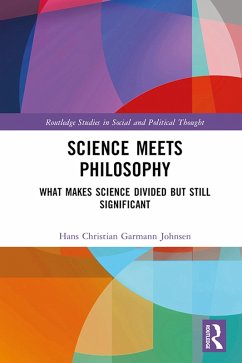
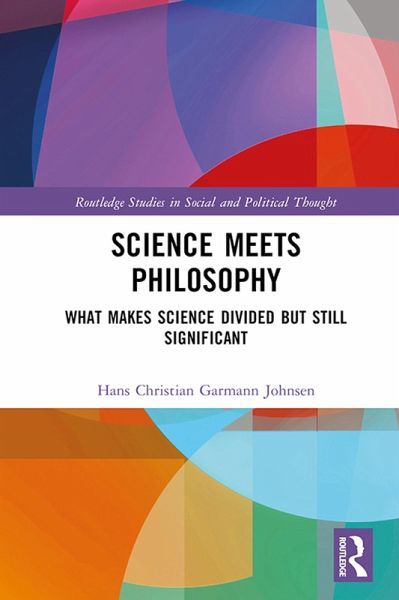
Science Meets Philosophy (eBook, ePUB)
What Makes Science Divided but Still Significant
Versandkostenfrei!
Sofort per Download lieferbar
39,95 €
inkl. MwSt.
Weitere Ausgaben:

PAYBACK Punkte
20 °P sammeln!

The book is an attempt to bring together what are often seen as incommensurable scientific and philosophical positions. Its core argument is that a main reason for the divisions about what constitutes scientific knowledge relates to disagreements on philosophical issues. The book explores what these disagreements are about, and discusses whether they can be overcome.Taking a historical perspective, the book traces the divides in science back to three main philosophical traditions: realism, idealism, and scepticism. It maps how these have inspired three main current positions in science: logica...
The book is an attempt to bring together what are often seen as incommensurable scientific and philosophical positions. Its core argument is that a main reason for the divisions about what constitutes scientific knowledge relates to disagreements on philosophical issues. The book explores what these disagreements are about, and discusses whether they can be overcome.
Taking a historical perspective, the book traces the divides in science back to three main philosophical traditions: realism, idealism, and scepticism. It maps how these have inspired three main current positions in science: logical empiricism, phenomenology, and sociology of scientific knowledge.
The book is intended for a general audience concerned with today's debates on scientific knowledge and society. It will be useful for students and researchers studying philosophy of science, sociology of scientific knowledge, realism, phenomenology, positivism, logical empiricism, analytical philosophy, and sustainable scientific knowledge.
Taking a historical perspective, the book traces the divides in science back to three main philosophical traditions: realism, idealism, and scepticism. It maps how these have inspired three main current positions in science: logical empiricism, phenomenology, and sociology of scientific knowledge.
The book is intended for a general audience concerned with today's debates on scientific knowledge and society. It will be useful for students and researchers studying philosophy of science, sociology of scientific knowledge, realism, phenomenology, positivism, logical empiricism, analytical philosophy, and sustainable scientific knowledge.
Dieser Download kann aus rechtlichen Gründen nur mit Rechnungsadresse in A, B, BG, CY, CZ, D, DK, EW, E, FIN, F, GR, HR, H, IRL, I, LT, L, LR, M, NL, PL, P, R, S, SLO, SK ausgeliefert werden.
Andere Kunden interessierten sich für