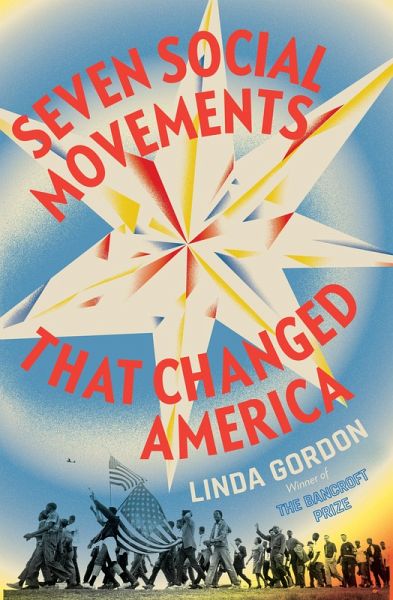
Seven Social Movements That Changed America (eBook, ePUB)
Versandkostenfrei!
Sofort per Download lieferbar
20,95 €
inkl. MwSt.
Weitere Ausgaben:

PAYBACK Punkte
10 °P sammeln!

A brilliantly conceived and provocative work from an award-winning historian that examines how seven twentieth-century social movements transformed America. How do social movements arise, wield power, and bring about meaningful change? Renowned scholar Linda Gordon investigates these and other salient questions in this visionary, cautionary, timely, and utterly necessary book (Nicole Eustace), narrating how some of America's most influential twentieth-century social movements transformed the nation. Beginning with the turn-of-the century settlement house movement, the book compares Chicago's c...
A brilliantly conceived and provocative work from an award-winning historian that examines how seven twentieth-century social movements transformed America.
How do social movements arise, wield power, and bring about meaningful change? Renowned scholar Linda Gordon investigates these and other salient questions in this visionary, cautionary, timely, and utterly necessary book (Nicole Eustace), narrating how some of America's most influential twentieth-century social movements transformed the nation.
Beginning with the turn-of-the century settlement house movement, the book compares Chicago's celebrated Hull-House, begun by privileged women, to a much less well known African American project, Cleveland's Phillis Wheatley House, begun by a former sharecropper. Expanding her highly praised book The Second Coming of the KKK, the second chapter shows how a northern Klan became a mass movement in the 1920s. Contrary to what many Klan opponents thought, this KKK was a middle-class organization, its members primarily urban and well educated. In the 1930s, the KKK gave birth to dozens of American fascist groupssmall but extremely violent. Profiles of two other 1930s movements follow: the Townsend campaign for old-age insurance, named for its charismatic leader, Dr. Francis Townsend. It created the public pressure that brought us Social Security, which was considered radical at the time, as was the movement to bring about federal unemployment aid for millions.
Proceeding to the 19551956 Montgomery bus boycottwhich jump-started the career of Martin Luther King, Jr.the narrative shows how the city's entire Black population refused to ride segregated buses; initiated by Black women, their years-long, hard-fought victory inspired the civil rights movement. Gordon then examines the 1970s farmworkers struggle, led by Cesar Chavez and made possible by the work of tens of thousands of the primarily Mexican American farmworkers. Together they built the United Farm Workers Union, winning better wages and working conditions for some of the country's poorest workers. The book concludes with the dramatic stories of two Boston socialist feminist groups, Bread and Roses and the Combahee River Collective, which influenced the whole women's liberation movement.
Throughout the work, Gordon concentrates not on ideologies but on how millions of grassroots activists strategized and changed the United States. Separately and together, these seven narratives bring to life the creativity and hard work of social movements, and in doing so reveal how they have been central to American history, in stories that reverberate with today's political activism.
How do social movements arise, wield power, and bring about meaningful change? Renowned scholar Linda Gordon investigates these and other salient questions in this visionary, cautionary, timely, and utterly necessary book (Nicole Eustace), narrating how some of America's most influential twentieth-century social movements transformed the nation.
Beginning with the turn-of-the century settlement house movement, the book compares Chicago's celebrated Hull-House, begun by privileged women, to a much less well known African American project, Cleveland's Phillis Wheatley House, begun by a former sharecropper. Expanding her highly praised book The Second Coming of the KKK, the second chapter shows how a northern Klan became a mass movement in the 1920s. Contrary to what many Klan opponents thought, this KKK was a middle-class organization, its members primarily urban and well educated. In the 1930s, the KKK gave birth to dozens of American fascist groupssmall but extremely violent. Profiles of two other 1930s movements follow: the Townsend campaign for old-age insurance, named for its charismatic leader, Dr. Francis Townsend. It created the public pressure that brought us Social Security, which was considered radical at the time, as was the movement to bring about federal unemployment aid for millions.
Proceeding to the 19551956 Montgomery bus boycottwhich jump-started the career of Martin Luther King, Jr.the narrative shows how the city's entire Black population refused to ride segregated buses; initiated by Black women, their years-long, hard-fought victory inspired the civil rights movement. Gordon then examines the 1970s farmworkers struggle, led by Cesar Chavez and made possible by the work of tens of thousands of the primarily Mexican American farmworkers. Together they built the United Farm Workers Union, winning better wages and working conditions for some of the country's poorest workers. The book concludes with the dramatic stories of two Boston socialist feminist groups, Bread and Roses and the Combahee River Collective, which influenced the whole women's liberation movement.
Throughout the work, Gordon concentrates not on ideologies but on how millions of grassroots activists strategized and changed the United States. Separately and together, these seven narratives bring to life the creativity and hard work of social movements, and in doing so reveal how they have been central to American history, in stories that reverberate with today's political activism.
Dieser Download kann aus rechtlichen Gründen nur mit Rechnungsadresse in A, D ausgeliefert werden.
Andere Kunden interessierten sich für
![Cover A Short History of Reconstruction [Updated Edition] (eBook, ePUB)](https://bilder.buecher.de/produkte/42/42026/42026854n.jpg "A Short History of Reconstruction [Updated Edition] (eBook, ePUB)")