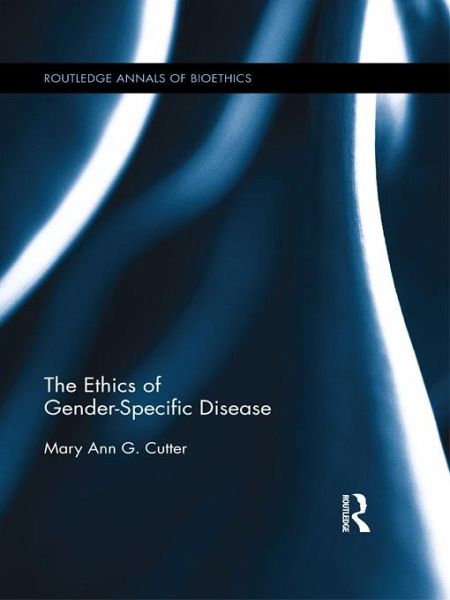
The Ethics of Gender-Specific Disease (eBook, PDF)
Versandkostenfrei!
Sofort per Download lieferbar
21,95 €
inkl. MwSt.
Weitere Ausgaben:

PAYBACK Punkte
11 °P sammeln!

Our understanding of gender carries significant bioethical implications. An errant account of gender-specific disease can lead to overgeneralizations, undergeneralizations, and misdiagnoses. It can also lead to problems in the structure of health-care delivery, the creation of policy, and the development of clinical curricula.In this volume, Cutter argues that gender-specific disease and related bioethical discourses are philosophically integrative. Gender-specific disease is integrative because the descriptive roles of gender, disease, and their relation are inextricably tied to their prescri...
Our understanding of gender carries significant bioethical implications. An errant account of gender-specific disease can lead to overgeneralizations, undergeneralizations, and misdiagnoses. It can also lead to problems in the structure of health-care delivery, the creation of policy, and the development of clinical curricula.
In this volume, Cutter argues that gender-specific disease and related bioethical discourses are philosophically integrative. Gender-specific disease is integrative because the descriptive roles of gender, disease, and their relation are inextricably tied to their prescriptive roles within frames of reference. An integrative account of gender-specific disease carries ethical implications because our understanding of gender-specific disease is evaluative, and our evaluations of gender-specific disease entail judgments concerning the praiseworthiness and blameworthiness of a clinical event. Cutter supports a "both/and" emphasis on context and integration in relation to gender-specific disease and bioethical analyses.
While the text mainly focuses on gender-specific diseases that affect women, Cutter also includes examples involving men, children, and members of the LGBT community.
In this volume, Cutter argues that gender-specific disease and related bioethical discourses are philosophically integrative. Gender-specific disease is integrative because the descriptive roles of gender, disease, and their relation are inextricably tied to their prescriptive roles within frames of reference. An integrative account of gender-specific disease carries ethical implications because our understanding of gender-specific disease is evaluative, and our evaluations of gender-specific disease entail judgments concerning the praiseworthiness and blameworthiness of a clinical event. Cutter supports a "both/and" emphasis on context and integration in relation to gender-specific disease and bioethical analyses.
While the text mainly focuses on gender-specific diseases that affect women, Cutter also includes examples involving men, children, and members of the LGBT community.
Dieser Download kann aus rechtlichen Gründen nur mit Rechnungsadresse in A, B, BG, CY, CZ, D, DK, EW, E, FIN, F, GR, HR, H, IRL, I, LT, L, LR, M, NL, PL, P, R, S, SLO, SK ausgeliefert werden.
Andere Kunden interessierten sich für