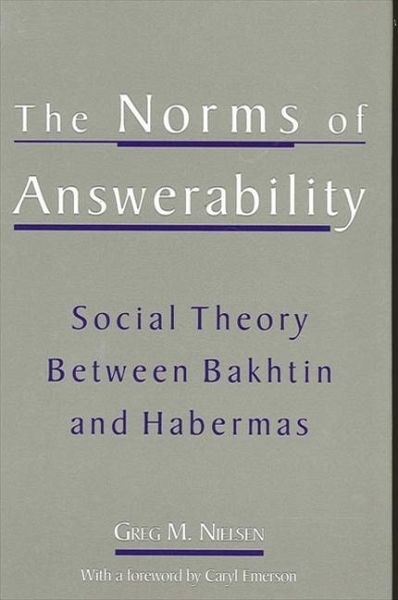
The Norms of Answerability (eBook, PDF)
Social Theory Between Bakhtin and Habermas
Versandkostenfrei!
Sofort per Download lieferbar
25,95 €
inkl. MwSt.
Weitere Ausgaben:

PAYBACK Punkte
13 °P sammeln!

Explores the relevance of Bakhtin's thought to social theory.Greg M. Nielsen brings Mikhail Bakhtin's ethics and aesthetics into a dialogue with social theory that responds to the sense of ambivalence and uncertainty at the core of modern societies. Nielsen situates a social theory between Bakhtin's norms of answerability and Jürgen Habermas's sociology, ethics, and discourse theory of democracy in a way that emphasizes the creative dimension in social action without reducing explanation to the emotional and volitional impulse of the individual or collective actor. Some of the classical sourc...
Explores the relevance of Bakhtin's thought to social theory.
Greg M. Nielsen brings Mikhail Bakhtin's ethics and aesthetics into a dialogue with social theory that responds to the sense of ambivalence and uncertainty at the core of modern societies. Nielsen situates a social theory between Bakhtin's norms of answerability and Jürgen Habermas's sociology, ethics, and discourse theory of democracy in a way that emphasizes the creative dimension in social action without reducing explanation to the emotional and volitional impulse of the individual or collective actor. Some of the classical sources that support this mediated position are traced to Alexander Vvedenskij's and Georg Simmel's critiques of Kant's ethics, Hermann Cohen's philosophy of fellowship, and Max Weber's and George Herbert Mead's theories of action. In the shift from Bakhtin's theory of interpersonal relations to a dialogic theory of societal events that defends the bold claim that law and politics should not be completely separated from the specificity of ethical and cultural communities, a study of citizenship and national identity is developed.
Greg M. Nielsen brings Mikhail Bakhtin's ethics and aesthetics into a dialogue with social theory that responds to the sense of ambivalence and uncertainty at the core of modern societies. Nielsen situates a social theory between Bakhtin's norms of answerability and Jürgen Habermas's sociology, ethics, and discourse theory of democracy in a way that emphasizes the creative dimension in social action without reducing explanation to the emotional and volitional impulse of the individual or collective actor. Some of the classical sources that support this mediated position are traced to Alexander Vvedenskij's and Georg Simmel's critiques of Kant's ethics, Hermann Cohen's philosophy of fellowship, and Max Weber's and George Herbert Mead's theories of action. In the shift from Bakhtin's theory of interpersonal relations to a dialogic theory of societal events that defends the bold claim that law and politics should not be completely separated from the specificity of ethical and cultural communities, a study of citizenship and national identity is developed.
Dieser Download kann aus rechtlichen Gründen nur mit Rechnungsadresse in A, D ausgeliefert werden.
Andere Kunden interessierten sich für