Gutscheinbedingungen

**Gültig vom 15.06.2026 bis 17.06.2026 | Gültig für nicht preisgebundene fremdsprachige Bücher | Einzelne Artikel können ausgeschlossen sein | Maximaler rabattfähiger Warenkorbwert 500 € | Nicht kombinierbar mit weiteren Aktionen | Nur einmal pro Person einlösbar | Nur solange der Vorrat reicht

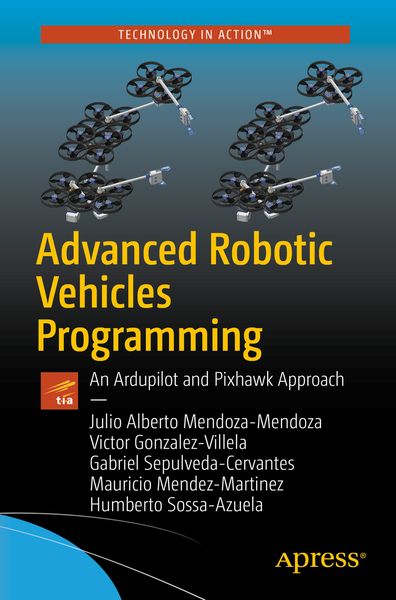
Produktbild: Advanced Robotic Vehicles Programming
- 15%

Advanced Robotic Vehicles Programming An Ardupilot and Pixhawk Approach

15% sparen

49,99 € UVP 58,84 €

inkl. gesetzl. MwSt., Versandkostenfrei

Lieferung nach Hause

Beschreibung

Produktdetails

Einband

Taschenbuch

Erscheinungsdatum

04.02.2020

Abbildungen

XXVIII, 219 illus., 138 illus. in color., schwarz-weiss Illustrationen, farbige Illustrationen

Verlag

Apress

Seitenzahl

439

Maße (L/B/H)

23,5/15,5/2,5 cm

Gewicht

708 g

Auflage

1st ed.

Sprache

Englisch

ISBN

978-1-4842-5530-8

Beschreibung

Produktdetails

Einband

Taschenbuch

Erscheinungsdatum

04.02.2020

Abbildungen

XXVIII, 219 illus., 138 illus. in color., schwarz-weiss Illustrationen, farbige Illustrationen

Verlag

Apress

Seitenzahl

439

Maße (L/B/H)

23,5/15,5/2,5 cm

Gewicht

708 g

Auflage

1st ed.

Sprache

Englisch

ISBN

978-1-4842-5530-8

Herstelleradresse

Libri GmbH
Europaallee 1
36244 Bad Hersfeld
DE

Email: gpsr@libri.de

Kundinnen und Kunden meinen

0 Bewertungen

Informationen zu Bewertungen

Zur Abgabe einer Bewertung ist eine Anmeldung im Konto notwendig. Die Authentizität der Bewertungen wird von uns nicht überprüft. Wir behalten uns vor, Bewertungstexte, die unseren Richtlinien widersprechen, entsprechend zu kürzen oder zu löschen.

Die Bewertungen sind nach Format, Anzahl Sterne und Datum sortiert.

Verfassen Sie die erste Bewertung zu diesem Artikel

Helfen Sie anderen Kund*innen durch Ihre Meinung

Kundinnen und Kunden meinen

0 Bewertungen filtern

  • Produktbild: Advanced Robotic Vehicles Programming
  • Part 1: Introduction

    Chapter 1: Hardware and Software Description• Definition of Autopilot• Autopilot classification by its programming method GUI vs SDK• Types of SDK• Pixhawk Autopilot (hardware)• Clones vs Originals• Commercial autopilot vs owndesign• Ardupilot Libraries (software)• Compatibilities and other similar projects• Confusion between hardware and software?

    Chapter 2: Ardupilot Working Environment• File types and  Ardupilot libraries• Use of specific data types• Description and flow of the programs to be used• Loading custom codes to the pixhawk using mission planner• Making new projects using the added eclipse interface• Identification of errors • Is it possible to use the Arduino directly with the APM libraries?

    Chapter 3: Recap and Definitions• Description of the auxiliary components• Computational efficiency vs mathematical equality• Working with variables, functions, modules and objects?• Getter and setter concept• Concept of orientation and position• Difference between installation and coding• Usual parts of an Ardupilot code• Usual models of programming on Ardupilot codes

    References and suggested websites of Part 1

    Part 2: Sequential Mode

    Chapter 4: Basic Input and Output Operations• About the header• About the setup• Writing to terminal• Terminal reading• Reading radios• Reading of orientation and position internal sensors• Reading of external position sensors (GPS)• Reading analog external sensors• Signal filtering• Reading and writing of external digital equipment• Battery reading• Use of visual alerts through the onboard LED

    Chapter 5: Advanced Operations: Serial Communications, Data Storage, Motion Units and Basis of Time Management• Wired and wireless serial communication• Interface with development cards• Writing to brushless motors• Code optimization• Writing to brushed motors• Use of stepper motors• Use of servomotors for auxiliary applications• Summary of the control of various compatible motors• Storage and use of flight data• Using the MissionPlanner GUI to plot flight data• Use of time

    Chapter 6:  Application to Quadcopter Drone Control with a Smooth Flight Mode: • Modeling and Basic Control of a Multirotor with Application Code

    References and suggested websites of Part 2

    Part 3: Real Time Mode

    Chapter 7: Real Time Working Environment• Notions of modular programming• Description of the scheduler• Usual parts of an ardupilot code in parallel mode• Measurement of the time of execution of a task

    Chapter 8: Compendium of the Previous Chapters in Real Time Mode with Application Code

    References and suggested websites of Part 3

    Appendices

    • Libraries installation• Comparison of commands with other SDKs• Thrust vectoring• Omnidirectionality• Methods of extended power • Extended header code• Extended setup code• Summary of the design of a quadcopter