KI-Beratung Beta

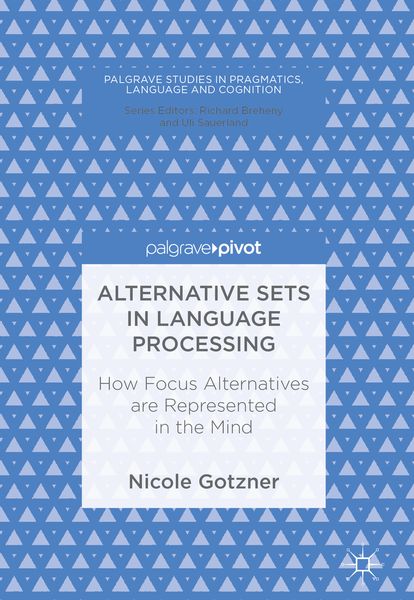
Produktbild: Alternative Sets in Language Processing

Alternative Sets in Language Processing How Focus Alternatives are Represented in the Mind

54,99 €

inkl. gesetzl. MwSt., Versandkostenfrei


Beschreibung

This book presents a novel experimental approach to investigating the mental representation of linguistic alternatives. Combining theoretical and psycholinguistic questions concerning the nature of alternative sets, it sheds new light on the theory of focus and the cognitive mechanisms underlying the...

Beschreibung

This book presents a novel experimental approach to investigating the mental representation of linguistic alternatives. Combining theoretical and psycholinguistic questions concerning the nature of alternative sets, it sheds new light on the theory of focus and the cognitive mechanisms underlying the processing of alternatives. In a series of language comprehension experiments, the author shows that intonational focus and focus particles such as ‘only’ shape the representation of alternatives in a listener’s mind in a fundamental way. This book is relevant to researchers interested in semantics, pragmatics, language processing and memory.

Produktdetails

Einband

Gebundene Ausgabe

Erscheinungsdatum

13.02.2017

Abbildungen

XIV, 162 p. 15 illus., 12 illus. in color.

Verlag Springer

Produktdetails

Einband

Gebundene Ausgabe

Erscheinungsdatum

13.02.2017

Abbildungen

XIV, 162 p. 15 illus., 12 illus. in color.

Verlag Springer
Seitenzahl

162

Maße (L/B/H)

21,6/15,3/1,5 cm

Gewicht

309 g

Auflage

1st ed. 2017

Sprache

Englisch

ISBN

978-3-319-52760-4

Herstelleradresse

Springer-Verlag GmbH
Europaplatz 3
69115 Heidelberg
DE

Email: ProductSafety@springernature.com

Noch keine Bewertungen vorhanden

Verfassen Sie die erste Bewertung zu diesem Artikel

Helfen Sie anderen Kundinnen und Kunden durch Ihre Meinung.

Kundinnen und Kunden meinen

Bewertungen (0)

  • Produktbild: Alternative Sets in Language Processing

  • Chapter 1. Introduction.- Chapter 2. Theoretical and empirical background.- Chapter 3. Long-term representation of the entire alternative set.- Chapter 4. The mechanisms of activation and competitive inhibition.- Chapter 5. What's included in the set of alternatives?.- Chapter 6. Contrastive pitch accents and focus particles.- Chapter 7. Conclusions.