Gutscheinbedingungen

**Gültig vom 15.06.2026 bis 17.06.2026 | Gültig für nicht preisgebundene fremdsprachige Bücher | Einzelne Artikel können ausgeschlossen sein | Maximaler rabattfähiger Warenkorbwert 500 € | Nicht kombinierbar mit weiteren Aktionen | Nur einmal pro Person einlösbar | Nur solange der Vorrat reicht

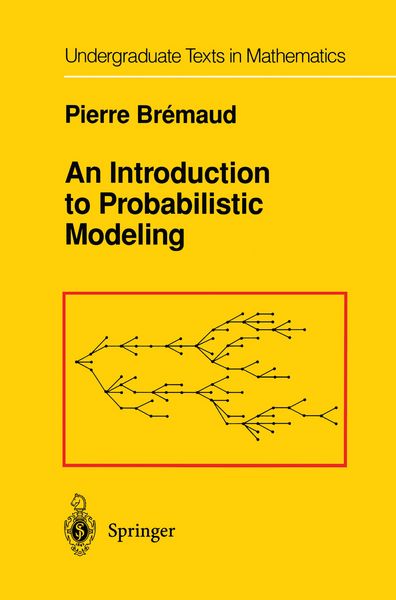
  • Produktbild: An Introduction to Probabilistic Modeling
  • Produktbild: An Introduction to Probabilistic Modeling

An Introduction to Probabilistic Modeling

63,99 €

inkl. gesetzl. MwSt., Versandkostenfrei

Lieferung nach Hause

Beschreibung

Produktdetails

Einband

Taschenbuch

Erscheinungsdatum

17.10.2012

Verlag

Springer Us

Seitenzahl

208

Maße (L/B/H)

23,5/15,5/1,3 cm

Gewicht

352 g

Auflage

Softcover reprint of the original 1st ed. 1988

Sprache

Englisch

ISBN

978-1-4612-6996-0

Beschreibung

Produktdetails

Einband

Taschenbuch

Erscheinungsdatum

17.10.2012

Verlag

Springer Us

Seitenzahl

208

Maße (L/B/H)

23,5/15,5/1,3 cm

Gewicht

352 g

Auflage

Softcover reprint of the original 1st ed. 1988

Sprache

Englisch

ISBN

978-1-4612-6996-0

Herstelleradresse

Springer-Verlag KG
Sachsenplatz 4-6
1201 Wien
AT

Email: ProductSafety@springernature.com

Kundinnen und Kunden meinen

0 Bewertungen

Informationen zu Bewertungen

Zur Abgabe einer Bewertung ist eine Anmeldung im Konto notwendig. Die Authentizität der Bewertungen wird von uns nicht überprüft. Wir behalten uns vor, Bewertungstexte, die unseren Richtlinien widersprechen, entsprechend zu kürzen oder zu löschen.

Die Bewertungen sind nach Format, Anzahl Sterne und Datum sortiert.

Verfassen Sie die erste Bewertung zu diesem Artikel

Helfen Sie anderen Kund*innen durch Ihre Meinung

Kundinnen und Kunden meinen

0 Bewertungen filtern

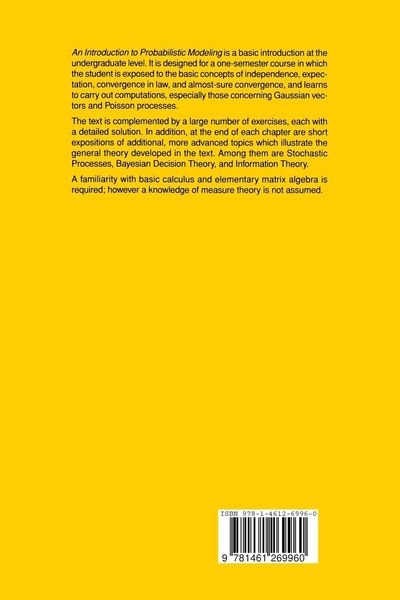
  • Produktbild: An Introduction to Probabilistic Modeling
  • Produktbild: An Introduction to Probabilistic Modeling
  • 1 Basic Concepts and Elementary Models.- 1. The Vocabulary of Probability Theory.- 2. Events and Probability.- 2.1. Probability Space.- 2.2. Two Elementary Probabilistic Models.- 3. Random Variables and Their Distributions.- 3.1. Random Variables.- 3.2. Cumulative Distribution Function.- 4. Conditional Probability and Independence.- 4.1. Independence of Events.- 4.2. Independence of Random Variables.- 5. Solving Elementary Problems.- 5.1. More Formulas.- 5.2. A Small Bestiary of Exercises.- 6. Counting and Probability.- 7. Concrete Probability Spaces.- Illustration 1. A Simple Model in Genetics: Mendel’s Law and Hardy—Weinberg’s Theorem.- Illustration 2. The Art of Counting: The Ballot Problem and the Reflection Principle.- Illustration 3. Bertrand’s Paradox.- 2 Discrete Probability.- 1. Discrete Random Elements.- 1.1. Discrete Probability Distributions.- 1.2. Expectation.- 1.3. Independence.- 2. Variance and Chebyshev’s Inequality.- 2.1. Mean and Variance.- 2.2. Chebyshev’s Inequality.- 3. Generating Functions.- 3.1. Definition and Basic Properties.- 3.2. Independence and Product of Generating Functions.- Illustration 4. An Introduction to Population Theory: Galton—Watson’s Branching Process.- Illustration 5. Shannon’s Source Coding Theorem: An Introduction to Information Theory.- 3 Probability Densities.- I. Expectation of Random Variables with a Density.- 1.1. Univariate Probability Densities.- 1.2. Mean and Variance.- 1.3. Chebyshev’s Inequality.- 1.4. Characteristic Function of a Random Variable.- 2. Expectation of Functionals of Random Vectors.- 2.1. Multivariate Probability Densities.- 2.2. Covariance, Cross-Covariance, and Correlation.- 2.3. Characteristic Function of a Random Vector.- 3. Independence.- 3.1. Independent Random Variables.- 3.2. Independent Random Vectors.- 4. Random Variables That Are Not Discrete and Do Not Have a pd.- 4.1. The Abstract Definition of Expectation.- 4.2. Lebesgue’s Theorems and Applications.- Illustration 6. Buffon’s Needle: A Problem in Random Geometry.- 4 Gauss and Poisson.- 1. Smooth Change of Variables.- 1.1. The Method of the Dummy Function.- 1.2. Examples.- 2. Gaussian Vectors.- 2.1. Characteristic Function of Gaussian Vectors.- 2.2. Probability Density of a Nondegenerate Gaussian Vector.- 2.3. Moments of a Centered Gaussian Vector.- 2.4. Random Variables Related to Gaussian Vectors.- 3. Poisson Processes.- 3.1. Homogeneous Poisson Processes Over the Positive Half Line.- 3.2. Nonhomogeneous Poisson Processes Over the Positive Half Line.- 3.3. Homogeneous Poisson Processes on the Plane.- 4. Gaussian Stochastic Processes.- 4.1. Stochastic Processes and Their Law.- 4.2. Gaussian Stochastic Processes.- Illustration 7. An Introduction to Bayesian Decision Theory: Tests of Gaussian Hypotheses.- 5 Convergences.- 1. Almost-Sure Convergence.- 1.1. The Borel—Cantelli Lemma.- 1.2. A Criterion for Almost-Sure Convergence.- 1.3. The Strong Law of Large Numbers.- 2. Convergence in Law.- 2.1. Criterion of the Characteristic Function.- 2.2. The Central Limit Theorem.- 3. The Hierarchy of Convergences.- 3.1. Almost-Sure Convergence Versus Convergence in Probability.- 3.2. Convergence in the Quadratic Mean.- 3.3. Convergence in Law in the Hierarchy of Convergences.- 3.4. The Hierarchical Tableau.- Illustration 8. A Statistical Procedure: The Chi-Square Test.- Illustration 9. Introduction to Signal Theory: Filtering.- Additional Exercises.- Solutions to Additional Exercises.