KI-Beratung Beta

Gutscheinbedingungen

**Gültig vom 05.10.2026 bis 07.10.2026 | Gültig für nicht preisgebundene fremdsprachige Bücher | Einzelne Artikel können ausgeschlossen sein | Online auf www.bücher.de einlösbar | Click & Collect nur mit Online-Zahlung (Paypal/Kreditkarte) vorab | Nicht kombinierbar mit anderen Gutscheinen oder Preisaktionen | Nur einmal pro Einkauf einlösbar | Gutschein wird auf max. 500€ Bestellwert angerechnet | Keine Barauszahlung | Nicht gültig für Versandkosten und Services

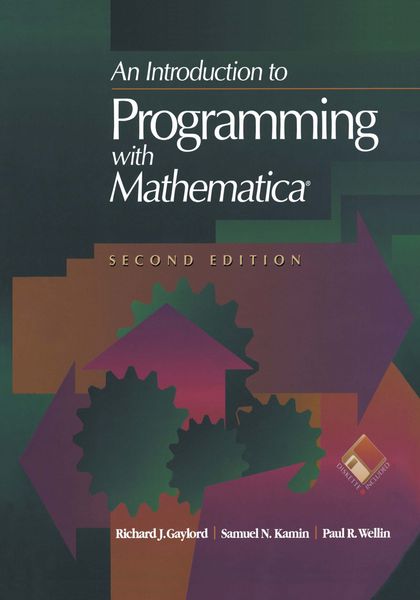
  • Produktbild: An Introduction to Programming with Mathematica®
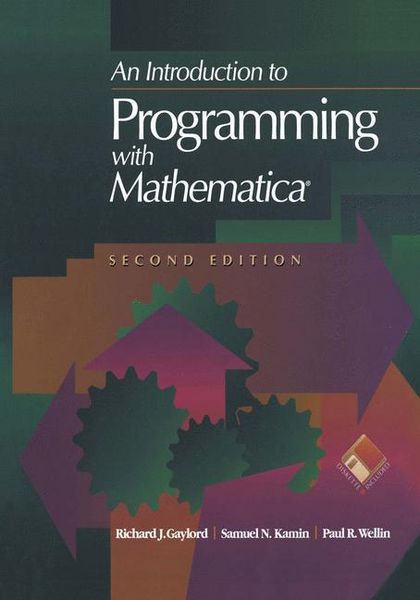
  • Produktbild: An Introduction to Programming with Mathematica®

An Introduction to Programming with Mathematica®

48,99 €

inkl. gesetzl. MwSt., Versandkostenfrei


Beschreibung

Produktdetails

Einband

Gebundene Ausgabe

Erscheinungsdatum

12.10.1995

Abbildungen

XXIII, 452 p.

Verlag

Springer Us

Seitenzahl

452

Maße (L/B/H)

24,1/18,3/3,1 cm

Gewicht

1011 g

Auflage

Second Edition 1996

Sprache

Englisch

ISBN

978-0-387-94434-0

Beschreibung

Produktdetails

Einband

Gebundene Ausgabe

Erscheinungsdatum

12.10.1995

Abbildungen

XXIII, 452 p.

Verlag

Springer Us

Seitenzahl

452

Maße (L/B/H)

24,1/18,3/3,1 cm

Gewicht

1011 g

Auflage

Second Edition 1996

Sprache

Englisch

ISBN

978-0-387-94434-0

Herstelleradresse

Springer-Verlag KG
Sachsenplatz 4-6
1201 Wien
AT

Email: ProductSafety@springernature.com

Noch keine Bewertungen vorhanden

Verfassen Sie die erste Bewertung zu diesem Artikel

Helfen Sie anderen Kundinnen und Kunden durch Ihre Meinung.

Kundinnen und Kunden meinen

Bewertungen (0)

  • Produktbild: An Introduction to Programming with Mathematica®
  • Produktbild: An Introduction to Programming with Mathematica®
  • 1 Preliminaries.- 1.1 Introduction.- 1.2 Using Mathematica.- 1.3 The Mathematica Language.- 1.4 The Mathematica Interface.- 2 A Brief Overview of Mathematica.- 2.1 Numerical and Symbolic Computations.- 2.2 Functions.- 2.3 Graphics.- 2.4 Representation of Data.- 2.5 Programming.- 3 List Manipulation.- 3.1 Introduction.- 3.2 Creating and Measuring Lists.- 3.3 Working With the Elements of a List.- 3.4 Working with Several Lists.- 3.5 Higher-Order Functions.- 3.6 Applying Functions to Lists Repeatedly.- 3.7 Strings and Characters.- 4 Functions.- 4.1 Introduction.- 4.2 Programs as Functions.- 4.3 User-Defined Functions.- 4.4 Auxiliary Functions.- 4.5 Anonymous Functions.- 4.6 One-Liners.- 5 Evaluation of Expressions.- 5.1 Introduction.- 5.2 Creating Rewrite Rules.- 5.3 Expressions.- 5.4 Patterns.- 5.5 Term Rewriting.- 5.6 Transformation Rules.- 6 Conditional Function Definitions.- 6.1 Introduction.- 6.2 Conditional Functions.- 6.3 Example—Classifying Points.- 7 Recursion.- 7.1 Fibonacci Numbers.- 7.2 List Functions.- 7.3 Thinking Recursively.- 7.4 Recursion and Symbolic Computations.- 7.5 Gaussian Elimination.- 7.6 Trees.- 7.7 Dynamic Programming.- 7.8 Higher-Order Functions and Recursion.- 7.9 Debugging.- 8 Iteration.- 8.1 Newtons Method.- 8.2 Vectors and Matrices.- 8.3 Passing Arrays to Functions.- 8.4 Gaussian Elimination Revisited.- 9 Numerics.- 9.1 Types of Numbers.- 9.2 Random Numbers.- 9.3 Precision and Accuracy.- 9.4 Numerical Computations.- 10 Graphics Programming.- 10.1 Graphics Primitives.- 10.2 Graphics Directives and Options.- 10.3 Built-in Graphics Functions.- 10.4 Graphics Programming.- 10.5 Sound.- 11 Applications.- 11.1 The Random Walk.- 11.2 The Game of Life.- 11.3 Implementing Languages.- 12 Contexts and Packages.- 12.1 Introduction.- 12.2 UsingPackages.- 12.3 Contexts.- 12.4 Packages.- 12.5 Avoiding Name Collisions.- 12.6 The BaseConvert Package.- 12.7 The RandomWalks Package.- References.