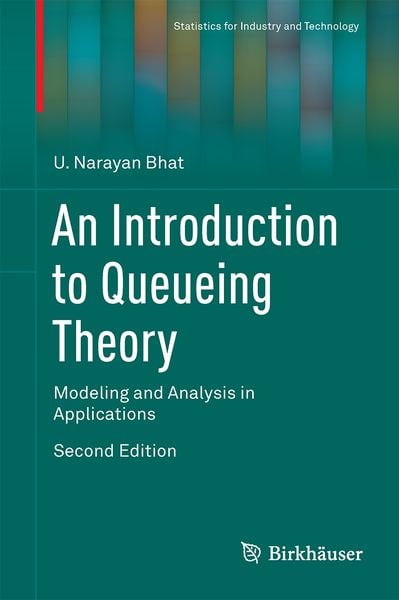
An Introduction to Queueing Theory Modeling and Analysis in Applications
123,99 €
UVP
149,79 €
inkl. gesetzl. MwSt.,
Beschreibung
Produktdetails
Einband
Gebundene Ausgabe
Erscheinungsdatum
09.07.2015
Abbildungen
XIV, 339 p. 18 illus., 6 illus. in color.
Verlag
Birkhäuser BostonSeitenzahl
339
Maße (L/B/H)
24,1/16/2,4 cm
Gewicht
699 g
Auflage
2nd ed. 2015
Sprache
Englisch
ISBN
978-0-8176-8420-4
This introductory textbook is designed for a one-semester course on queueing theory that does not require a course on stochastic processes as a prerequisite. By integrating the necessary background on stochastic processes with the analysis of models, the work provides a sound foundational introduction to the modeling and analysis of queueing systems for a broad interdisciplinary audience of students in mathematics, statistics, and applied disciplines such as computer science, operations research, and engineering. This edition includes additional topics in methodology and applications.
Key features:
• An introductory chapter including a historical account of the growth of queueing theory in more than 100 years.
• A modeling-based approach with emphasis on identification of models
• Rigorous treatment of the foundations of basic models commonly used in applications with appropriate references for advanced topics.
• A chapter on matrix-analytic method asan alternative to the traditional methods of analysis of queueing systems.
• A comprehensive treatment of statistical inference for queueing systems.
• Modeling exercises and review exercises when appropriate.
The second edition of An Introduction of Queueing Theory may be used as a textbook by first-year graduate students in fields such as computer science, operations research, industrial and systems engineering, as well as related fields such as manufacturing and communications engineering. Upper-level undergraduate students in mathematics, statistics, and engineering may also use the book in an introductory course on queueing theory. With its rigorous coverage of basic material and extensive bibliography of the queueing literature, the work may also be useful to applied scientists and practitioners as a self-study reference for applications and further research.
"...This book has brought a freshness and novelty as it deals mainly with modeling and analysis in applications as well as with statistical inference for queueing problems. With his 40 years of valuable experience in teaching and high level research in this subject area, Professor Bhat has been able to achieve what he aimed: to make [the work] somewhat different in content and approach from other books." - Assam Statistical Review of the first edition
Noch keine Bewertungen vorhanden
Verfassen Sie die erste Bewertung zu diesem Artikel
Helfen Sie anderen Kundinnen und Kunden durch Ihre Meinung.
Kurze Frage zu unserer Seite
Vielen Dank für dein Feedback
Wir nutzen dein Feedback, um unsere Produktseiten zu verbessern. Bitte habe Verständnis, dass wir dir keine Rückmeldung geben können. Falls du Kontakt mit uns aufnehmen möchtest, kannst du dich aber gerne an unseren Kund*innenservice wenden.
zum Kundenservice