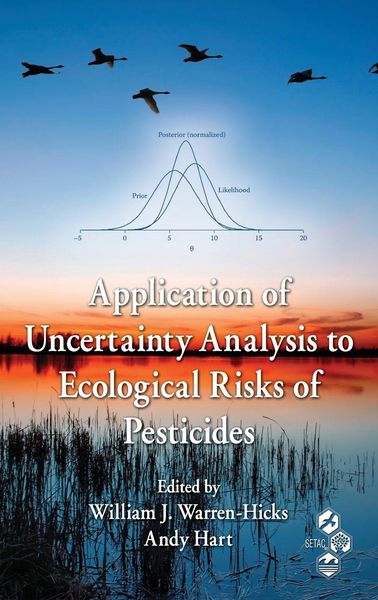
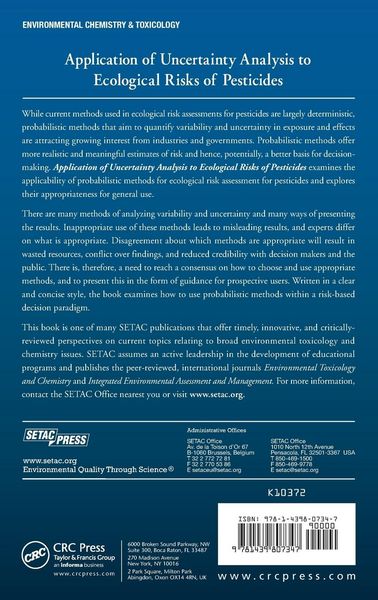
• Produktbild: Application of Uncertainty Analysis to Ecological Risks of Pesticides
  • Produktbild: Application of Uncertainty Analysis to Ecological Risks of Pesticides

Application of Uncertainty Analysis to Ecological Risks of Pesticides

334,99 €

inkl. gesetzl. MwSt., Versandkostenfrei

Lieferung nach Hause

Beschreibung

Produktdetails

Einband

Gebundene Ausgabe

Erscheinungsdatum

07.04.2010

Abbildungen

schwarz-weiss Illustrationen, Tabellen, schwarz-weiss

Herausgeber

Warren-Hicks William J. + weitere

Verlag

Taylor & Francis

Seitenzahl

228

Maße (L/B/H)

24/16,1/1,7 cm

Gewicht

521 g

Sprache

Englisch

ISBN

978-1-4398-0734-7

Beschreibung

Produktdetails

Einband

Gebundene Ausgabe

Erscheinungsdatum

07.04.2010

Abbildungen

schwarz-weiss Illustrationen, Tabellen, schwarz-weiss

Herausgeber

Verlag

Taylor & Francis

Seitenzahl

228

Maße (L/B/H)

24/16,1/1,7 cm

Gewicht

521 g

Sprache

Englisch

ISBN

978-1-4398-0734-7

Kundinnen und Kunden meinen

0 Bewertungen

Informationen zu Bewertungen

Zur Abgabe einer Bewertung ist eine Anmeldung im Konto notwendig. Die Authentizität der Bewertungen wird von uns nicht überprüft. Wir behalten uns vor, Bewertungstexte, die unseren Richtlinien widersprechen, entsprechend zu kürzen oder zu löschen.

Die Bewertungen sind nach Format, Anzahl Sterne und Datum sortiert.

Verfassen Sie die erste Bewertung zu diesem Artikel

Helfen Sie anderen Kund*innen durch Ihre Meinung

Kundinnen und Kunden meinen

0 Bewertungen filtern

  • Produktbild: Application of Uncertainty Analysis to Ecological Risks of Pesticides
  • Produktbild: Application of Uncertainty Analysis to Ecological Risks of Pesticides
  • Introduction and Objectives, A. Hart, D. Farrar, D. Urban, D. Fischer, T. La Point, K. Romijn, and S. FersonIntroductionVariability and UncertaintyImportance of Variability and Uncertainty in Risk AssessmentCurrent Methods for Dealing with Variability and Uncertainty Are InadequateVariability and Uncertainty Hinder the Regulatory ProcessUnderstanding Uncertainty and Variability Is Critical When Developing a Credible Risk AssessmentQuantitative Analysis of Variability and Uncertainty Can HelpWhen Is Quantitative Analysis of Variability and Uncertainty Required?What If the Bounds Are Very Wide?Need for Consensus on Appropriate MethodsWorkshop Objectives and Key IssuesReferences Problem Formulation for Probabilistic Ecological Risk Assessments, A. Hart, S. Ferson, J. Shaw, G. W. Suter II, P. F. Chapman, P. L. de Fur, W. Heger, and P. D. JonesIntroductionMain Steps in Problem FormulationIntegration of Available Information for Probabilistic AssessmentsDefinition of Assessment Endpoints for Probabilistic AssessmentsDefinition of Assessment ScenariosDeveloping Conceptual Models for Probabilistic AssessmentsAnalysis Plans for Probabilistic AssessmentReferences Issues Underlying the Selection of Distributions, D. Farrar, T. Barry, P. Hendley, M. Crane, P. Mineau, M. H. Russell, and E. W. OdenkirchenIntroductionTechnical BackgroundSome Practical Aspects of the Selection of Univariate DistributionsUsing Scanty and Fragmentary DataReferences Monte Carlo, Bayesian Monte Carlo, and First-Order Error Analysis, W. J. Warren-Hicks, S. Qian, J. Toll, D. L. Fischer, E. Fite, W. G. Landis, M. Hamer, and E. P. SmithIntroductionPractical Aspects of a Monte Carlo AnalysisMathematical and Statistical Underpinnings of Monte Carlo MethodsBayesian Monte Carlo AnalysisFirst-Order Error AnalysisA Monte Carlo Case Study: Derivation of Chronic Risk Curves for Atrazine in Tennessee Ponds Using Monte Carlo AnalysisConclusionsReferences The Bayesian Vantage for Dealing with Uncertainty, D. A. Evans, M. C. Newman, M. Lavine, J. S. Jaworska, J. Toll, B. Brooks, and T. C. M. BrockIntroductionConventional (Frequentist) Inference MethodsExperiments Change the State of KnowledgeRules of ProbabilityBayes’s TheoremExamples Relevant to Uncertainty in Risk Assessment Quantifying Plausibility of a Cause–Effect ModelConclusionReferences Bounding Uncertainty Analyses, S. Ferson, D. R. J. Moore, P. Van den Brink, T. L. Estes, K. Gallagher, R. O’Connor, and F. VerdonckIntroductionRobust BayesProbability Bounds AnalysisNumerical ExampleHow to Use Bounding ResultsSeven Challenges in Risk AnalysesWhat Bounding Cannot DoExample: Insectivorous Birds’ Exposure to PesticideConclusionAppendixReferences Uncertainty Analysis Using Classical and Bayesian Hierarchical Models, D. R. J. Moore, W. J. Warren-Hicks, S. Qian, A Fairbrother, T. Aldenberg, T. Barry, R. Luttik, and H.-T. RatteIntroductionVariability and UncertaintySimple 2nd-Order Monte Carlo Analysis Case StudyBayesian Hierarchical ModelingReferences Interpreting and Communicating Risk and Uncertainty for Decision Making, J. L. Shaw, K. R. Tucker, K. Aden, J. M. Giddings, D. M. Keehner, and C. KrizIntroductionParticipants in Risk CommunicationCommunicating Uncertainty to Stakeholders and ParticipantsProcess for CommunicationRisk Assessor and Decision Maker Roles and ResponsibilitiesCommunication of Uncertainty for Regulatory Decision MakingReferences How to Detect and Avoid Pitfalls, Traps, and Swindles, G. Joermann, T. W. La Point, L. A. Burns, J. P. Carbone, P. D. Delorme, S. Ferson, D. R. J. Moore, and T. P. TraasIntroductionMeaningful Problem FormulationSuitability of Input DataParameterization of the Distribution of Input VariablesCorrelations and DependenciesModel UncertaintiesSoftware Tools and Computational IssuesPresentation and Interpretation of ResultsConclusionsReferences Conclusions, A. Hart, T. Barry, D. L. Fischer, J. M. Giddings, P. Hendley, G. Joermann, R. Luttik, D. R. J. Moore, M. C. Newman, E. Odenkirchen, and J. L. ShawIntroductionWhich Methods of Uncertainty Analysis Are Appropriate under What Circumstances?What Are the Implications of Probabilistic Methods for Problem Formulation?How Can Uncertainty Analysis Methods Be Used Efficiently and Effectively in Decision Making?When and How Should We Separate Variability and Uncertainty?How Can We Take Account for Uncertainty Concerning the Structure of the Risk Model for the Assessment?How Should We Select and Parameterize Input Distributions When Data Are Limited?How Should We Deal with Dependencies, Including Nonlinear Dependencies and Dependencies about Which Only Partial Information Is Available?How Can We Take Account of Uncertainty When Combining Different Types of Information in an Assessment (e.g., Quantitative Data and Expert Judgment, Laboratory Data, and Field Data)?How Can We Detect and Avoid Misleading Results?How Can We Communicate Methods and Outputs Effectively to Decision Makers and Stakeholders?What Are the Priorities for Further Development, Implementation, and Training?ReferencesGlossary