• Produktbild: Automated Deduction - CADE-16
  • Produktbild: Automated Deduction - CADE-16

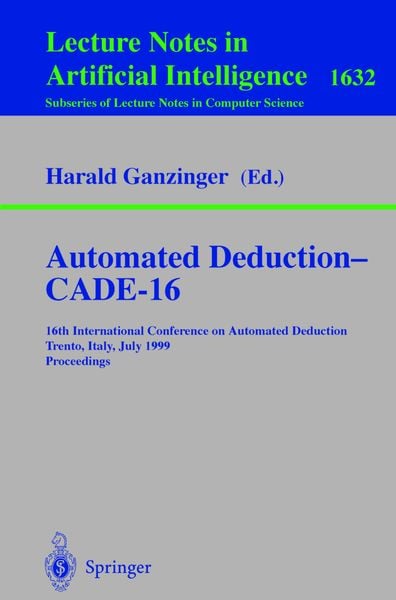
Automated Deduction - CADE-16 16 th International Conference on Automated Deduction, Trento, Italy, July 7-10, 1999. Proceedings

48,99 €

inkl. gesetzl. MwSt., Versandkostenfrei

Lieferung nach Hause

Beschreibung

Produktdetails

Einband

Taschenbuch

Erscheinungsdatum

23.06.1999

Herausgeber

Harald Ganzinger

Verlag

Springer Berlin

Seitenzahl

438

Maße (L/B/H)

23,5/15,5/2,4 cm

Gewicht

590 g

Auflage

1999

Sprache

Englisch

ISBN

978-3-540-66222-8

Beschreibung

Produktdetails

Einband

Taschenbuch

Erscheinungsdatum

23.06.1999

Herausgeber

Harald Ganzinger

Verlag

Springer Berlin

Seitenzahl

438

Maße (L/B/H)

23,5/15,5/2,4 cm

Gewicht

590 g

Auflage

1999

Sprache

Englisch

ISBN

978-3-540-66222-8

Herstelleradresse

Springer Nature Customer Service Center GmbH
Europaplatz 3
69115 Heidelberg
DE
ProductSafety@springernature.com

Kundinnen und Kunden meinen

0 Bewertungen

Informationen zu Bewertungen

Zur Abgabe einer Bewertung ist eine Anmeldung im Konto notwendig. Die Authentizität der Bewertungen wird von uns nicht überprüft. Wir behalten uns vor, Bewertungstexte, die unseren Richtlinien widersprechen, entsprechend zu kürzen oder zu löschen.

Die Bewertungen sind nach Format, Anzahl Sterne und Datum sortiert.

Verfassen Sie die erste Bewertung zu diesem Artikel

Helfen Sie anderen Kund*innen durch Ihre Meinung

Kundinnen und Kunden meinen

0 Bewertungen filtern

  • Produktbild: Automated Deduction - CADE-16
  • Produktbild: Automated Deduction - CADE-16
  • Session 1.- A Dynamic Programming Approach to Categorial Deduction.- Tractable Transformations from Modal Provability Logics into First-Order Logic.- Session 2.- Decision Procedures for Guarded Logics.- A PSpace Algorithm for Graded Modal Logic.- Session 3.- Solvability of Context Equations with Two Context Variables Is Decidable.- Complexity of the Higher Order Matching.- Solving Equational Problems Efficiently.- Session 4.- VSDITLU: A Verifiable Symbolic Definite Integral Table Look-Up.- A Framework for the Flexible Integration of a Class of Decision Procedures into Theorem Provers.- Presenting Proofs in a Human-Oriented Way.- Session 5.- On the Universal Theory of Varieties of Distributive Lattices with Operators: Some Decidability and Complexity Results.- Maslov’s Class K Revisited.- Prefixed Resolution: A Resolution Method for Modal and Description Logics.- Session 6: System Descriptions.- System Description: Twelf — A Meta-Logical Framework for Deductive Systems.- System Description: inka 5.0 - A Logic Voyager.- System Description: CutRes 0.1: Cut Elimination by Resolution.- System Description: MathWeb, an Agent-Based Communication Layer for Distributed Automated Theorem Proving.- System Description Using OBDD’s for the Validationof Skolem Verification Conditions.- Fault-Tolerant Distributed Theorem Proving.- System Description: Waldmeister — Improvements in Performance and Ease of Use.- Session 7.- Formal Metatheory Using Implicit Syntax, and an Application to Data Abstraction for Asynchronous Systems.- A Formalization of Static Analyses in System F.- On Explicit Reflection in Theorem Proving and Formal Verification.- Session 8: System Descriptions.- System Description: Kimba, A Model Generator for Many-Valued First-Order Logics.- System Description: Teyjus—A Compiler and Abstract Machine Based Implementation of ?Prolog.- Vampire.- System Abstract: E 0.3.- Session 9.- Invited Talk: Rewrite-Based Deduction and Symbolic Constraints.- Towards an Automatic Analysis of Security Protocols in First-Order Logic.- Session 10.- A Confluent Connection Calculus.- Abstraction-Based Relevancy Testing for Model Elimination.- A Breadth-First Strategy for Mating Search.- Session 11: System Competitions.- The Design of the CADE-16 Inductive Theorem Prover Contest.- Session 12: System Descriptions.- System Description: Spass Version 1.0.0.- K : A Theorem Prover for K.- System Description: CYNTHIA.- System Description: MCS: Model-Based Conjecture Searching.- Session 13.- Embedding Programming Languages in Theorem Provers.- Extensional Higher-Order Paramodulation and RUE-Resolution.- Automatic Generation of Proof Search Strategies for Second-Order Logic.