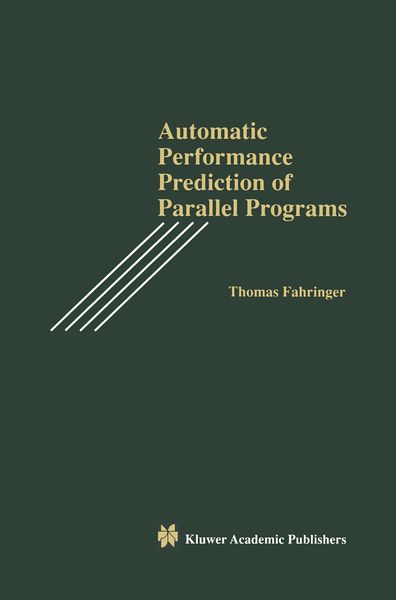
Automatic Performance Prediction of Parallel Programs
-
- Hardcover
- Taschenbuch ausgewählt
-
Sprache:Englisch
97,99 €
inkl. gesetzl. MwSt.,
Beschreibung
Produktdetails
Einband
Taschenbuch
Erscheinungsdatum
26.09.2011
Abbildungen
XX, 272 p.
Verlag
Springer UsSeitenzahl
272
Maße (L/B/H)
23,5/15,5/1,7 cm
Gewicht
452 g
Auflage
Softcover reprint of the original 1st edition 1996
Sprache
Englisch
ISBN
978-1-4612-8592-2
Automatic Performance Prediction of Parallel Programs
presents a unified approach to the problem of automatically estimating the performance of parallel computer programs. The author focuses primarily on distributed memory multiprocessor systems, although large portions of the analysis can be applied to shared memory architectures as well.
The author introduces a novel and very practical approach for predicting some of the most important performance parameters of parallel programs, including work distribution, number of transfers, amount of data transferred, network contention, transfer time, computation time and number of cache misses. This approach is based on advanced compiler analysis that carefully examines loop iteration spaces, procedure calls, array subscript expressions, communication patterns, data distributions and optimizing code transformations at the program level; and the most important machine specific parameters including cache characteristics, communication network indices, and benchmark data for computational operations at the machine level.
The material has been fully implemented as part of P
3
T, which is an integrated automatic performance estimator of the Vienna Fortran Compilation System (VFCS), a state-of-the-art parallelizing compiler for Fortran77, Vienna Fortran and a subset of High Performance Fortran (HPF) programs.
A large number of experiments using realistic HPF and Vienna Fortran code examples demonstrate highly accurate performance estimates, and the ability of the described performance prediction approach to successfully guide both programmer and compiler in parallelizing and optimizing parallel programs.
A graphical user interface is described and displayed that visualizes each program source line together with the corresponding parameter values. P
3
T uses color-coded performance visualization to immediately identify hot spots in the parallel program. Performance data can be filtered and displayed at various levels of detail. Colors displayed by the graphical user interface are visualized in greyscale.
Automatic Performance Prediction of Parallel Programs
also includes coverage of fundamental problems of automatic parallelization for distributed memory multicomputers, a description of the basic parallelization strategy and a large variety of optimizing code transformations as included under VFCS.
Noch keine Bewertungen vorhanden
Verfassen Sie die erste Bewertung zu diesem Artikel
Helfen Sie anderen Kundinnen und Kunden durch Ihre Meinung.
Kurze Frage zu unserer Seite
Vielen Dank für dein Feedback
Wir nutzen dein Feedback, um unsere Produktseiten zu verbessern. Bitte habe Verständnis, dass wir dir keine Rückmeldung geben können. Falls du Kontakt mit uns aufnehmen möchtest, kannst du dich aber gerne an unseren Kund*innenservice wenden.
zum Kundenservice