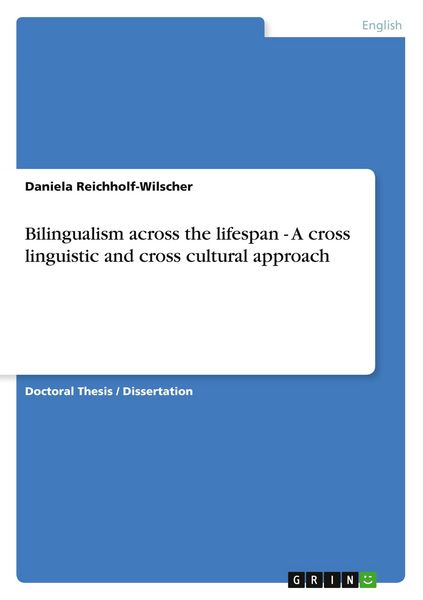
Bilingualism across the lifespan - A cross linguistic and cross cultural approach
-
- Englisch ausgewählt
52,95 €
inkl. gesetzl. MwSt.,
Beschreibung
Produktdetails
Einband
Taschenbuch
Erscheinungsdatum
14.11.2008
Abbildungen
24 Farbabb.
Verlag
GRINSeitenzahl
208
Maße (L/B/H)
21/14,8/1,5 cm
Gewicht
309 g
Auflage
3. Auflage
Sprache
Englisch
ISBN
978-3-640-20990-3
Doctoral Thesis / Dissertation from the year 2006 in the subject English Language and Literature Studies - Linguistics, grade: 1, University of Graz (Institut für Anglistik / Amerikanistik), language: English, abstract: The present thesis deals with the lives and languages of twenty-five adolescent and adult bilinguals. All of them have acquired their languages consecutively. Through an extensive research programme the subjects are tested from a cross-linguistic and cross-cultural approach for the quality of L1 - L2 proximity. The main research question in the thesis is in what ways do L1 and L2 of adolescent and adult bilinguals differ regarding the results of verbal screening tests and selected aspects of written narrative competence? How and to what extent can the findings be associated to the results of the analysis of influencing socio-psychological factors? It is assumed that biological constraints are not the single crucial factors for high levels of attainment but rather socio-psychological variables such as culture, identity, perception and attitudes. The verbal screening tests, namely the PPVT-III (Peabody Picture Vocabulary Test - III) and EVT (Expressive Vocabulary Test), used to determine a person¿s passive and active vocabulary knowledge of a language will show that the results of L1 and L2 will not differ significantly of each other in individuals showing positive affective variables in their bilingualism. The level of language proficiency and the quality of L1 - L2 proximity is further investigated through a detailed analysis of written narratives composed in ScriptLog, a research programme for the online process of writing. This involves the analysis of five major linguistic variables: productivity, lexical diversity, the construction of complex motion events, and the use of evaluative devices. The last two variables give information on the amount of granularity and the condensation of information and can be classified between textual structure and the lexicon. Additionally, the time data of the written narratives recorded by ScriptLog will be evaluated and discussed. The question is whether qualitative and quantitative differences between the five variables of investigation mentioned above are in line with sociopsychological variables, possibly influencing the development of late L2 learners.
Noch keine Bewertungen vorhanden
Verfassen Sie die erste Bewertung zu diesem Artikel
Helfen Sie anderen Kundinnen und Kunden durch Ihre Meinung.
Kurze Frage zu unserer Seite
Vielen Dank für dein Feedback
Wir nutzen dein Feedback, um unsere Produktseiten zu verbessern. Bitte habe Verständnis, dass wir dir keine Rückmeldung geben können. Falls du Kontakt mit uns aufnehmen möchtest, kannst du dich aber gerne an unseren Kund*innenservice wenden.
zum Kundenservice