
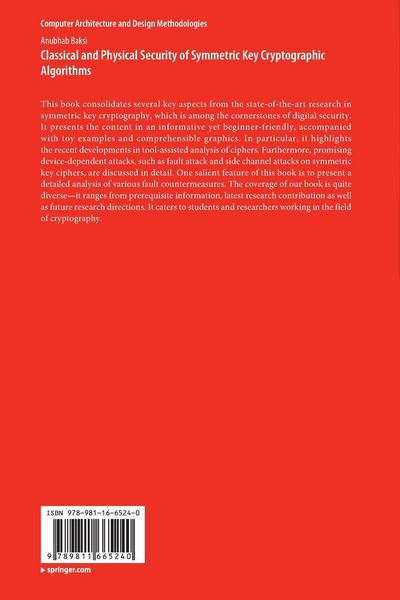
Classical and Physical Security of Symmetric Key Cryptographic Algorithms
-
- Hardcover
- Taschenbuch ausgewählt
- eBook
-
Sprache:Englisch
138,99 €
UVP
160,49 €
inkl. gesetzl. MwSt.,
Beschreibung
Produktdetails
Einband
Taschenbuch
Erscheinungsdatum
19.12.2022
Abbildungen
XII, 288 p. 89 illus., 78 illus. in color.
Verlag
Springer SingaporeSeitenzahl
288
Maße (L/B/H)
23,5/15,5/1,7 cm
Gewicht
458 g
Auflage
22001 Auflage 1st ed. 2022
Sprache
Englisch
ISBN
978-981-16-6524-0
This book consolidates several key aspects from the state-of-the-art research in symmetric key cryptography, which is among the cornerstones of digital security. It presents the content in an informative yet beginner-friendly, accompanied with toy examples and comprehensible graphics. In particular, it highlights the recent developments in tool-assisted analysis of ciphers. Furthermore, promising device-dependent attacks, such as fault attack and side channel attacks on symmetric key ciphers, are discussed in detail. One salient feature of this book is to present a detailed analysis of various fault countermeasures. The coverage of our book is quite diverse—it ranges from prerequisite information, latest research contribution as well as future research directions. It caters to students and researchers working in the field of cryptography.
Noch keine Bewertungen vorhanden
Verfassen Sie die erste Bewertung zu diesem Artikel
Helfen Sie anderen Kundinnen und Kunden durch Ihre Meinung.
Kurze Frage zu unserer Seite
Vielen Dank für dein Feedback
Wir nutzen dein Feedback, um unsere Produktseiten zu verbessern. Bitte habe Verständnis, dass wir dir keine Rückmeldung geben können. Falls du Kontakt mit uns aufnehmen möchtest, kannst du dich aber gerne an unseren Kund*innenservice wenden.
zum Kundenservice