• Produktbild: Clinical Application of Computational Mechanics to the Cardiovascular System
  • Produktbild: Clinical Application of Computational Mechanics to the Cardiovascular System
- 12%

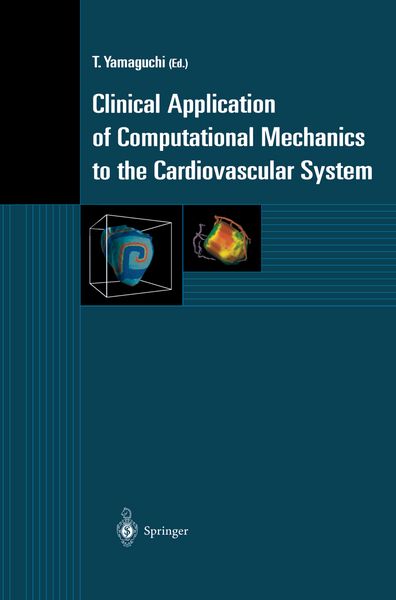
Clinical Application of Computational Mechanics to the Cardiovascular System

12% sparen

148,99 € UVP 171,19 €

inkl. gesetzl. MwSt., Versandkostenfrei


Beschreibung

Produktdetails

Einband

Taschenbuch

Erscheinungsdatum

03.10.2013

Abbildungen

XXXII, 288 p.

Herausgeber

T. Yamaguchi

Verlag

Springer Tokyo

Seitenzahl

288

Maße (L/B/H)

23,5/15,5/1,8 cm

Gewicht

493 g

Auflage

Softcover reprint of the original 1st edition 2000

Sprache

Englisch

ISBN

978-4-431-67989-9

Beschreibung

Produktdetails

Einband

Taschenbuch

Erscheinungsdatum

03.10.2013

Abbildungen

XXXII, 288 p.

Herausgeber

T. Yamaguchi

Verlag

Springer Tokyo

Seitenzahl

288

Maße (L/B/H)

23,5/15,5/1,8 cm

Gewicht

493 g

Auflage

Softcover reprint of the original 1st edition 2000

Sprache

Englisch

ISBN

978-4-431-67989-9

Herstelleradresse

Springer-Verlag GmbH
Tiergartenstr. 17
69121 Heidelberg
DE

Email: ProductSafety@springernature.com

Noch keine Bewertungen vorhanden

Verfassen Sie die erste Bewertung zu diesem Artikel

Helfen Sie anderen Kundinnen und Kunden durch Ihre Meinung.

Kundinnen und Kunden meinen

Bewertungen (0)

  • Produktbild: Clinical Application of Computational Mechanics to the Cardiovascular System
  • Produktbild: Clinical Application of Computational Mechanics to the Cardiovascular System
  • 1. General Aspects of Computational Cardiovascular Mechanics.- 1.1 Computational Mechanical Model Studies in the Cardiovascular System.- 1.2 Inelastic Constitutive Models of Blood Vessels in Physiological Conditions.- 1.3 Stress and Strain Analyses of Blood Vessels in Physiological and Pathological Conditions.- 1.4 Development of Interactive Modeling System for the Computational Biomechanics Simulation Using Medical Imaging Data.- 1.5 A Modeling System of 3-Dimensional Blood Vessel Configuration for CFD Analysis.- 2. Wall Motion and Blood Flow in the Heart.- 2.1 Computational Analysis for Mechanical Functions of Left Ventricle.- 2.2 Automated Tracking of Tagged Magnetic Resonance Image for Assessment of Regional Cardiac Wall Function.- 2.3 Error Estimation and Smoothing for Regional Deformation Analysis of the Heart with Tagged Magnetic Resonance Images.- 2.4 Deformation Analysis of Human Left Ventricular Wall Using Magnetic Resonance Tagging Technique.- 2.5 Motion and Strain Analyses of Left Ventricular Wall Using Optical Flow.- 2.6 Intraventricular Blood Flow Analysis Using Robust CFD Models.- 3. Interactions Between the Blood Flow and Wall Motion in Vascular System.- 3.1 Computational Fluid Mechanics of the Blood Flow in an Aortic Vessel with Realistic Geometry.- 3.2 Numerical Simulation and Experiment of Pulsatile Flow in Modeled Aortic Arch.- 3.3 Flow Simulation of the Aortic Arch —Effect of the 3D Distortion on Flows in the Ordinary Helix Circular Tube—.- 3.4 Computational Fluid Mechanics of the Vortical Flow in Blood Vessel.- 3.5 Computational Study on LDL Transfer from Flowing Blood to Arterial Walls.- 3.6 Numerical Simulation of Co-operative Regulation in the Cerebral Microvascular Arcadal Network.- 3.7 Computational Fluid Dynamic Simulation of the FlowThrough Venous Valve.- 4. Clinical and Electrophysiological Aspacts of Computational Mechanics of the Heart.- 4.1 A High-Performance Computation Method for Simulation of Cardiac Excitation Propagation Using a Supercomputer.- 4.2 Simulated Electrocardiogram of Spiral Wave Reentry in a Mathematical Ventricular Model.- 4.3 Computational Analysis and Visualization of Spiral Wave Reentry in a Virtual Heart Model.- 4.4 Simulation of Platelet Adhesion Using a Discrete Element Method.- 4.5 Computational Fluid Dynamics as a Tool to Develop the Artificial Heart.- 4.6 Three-Dimensional Image Processing and Motion Analysis of the Heart Using Radionuclide Medical Images.- 4.7 The Modeling of the Heart and the Aortic Arch Applying Differential Geometrical Method and Simulation of Blood Flow.- 4.8 Orientation Response of Stress Fibers in Cultured Cells Under Biaxial Cyclic Stretch: Hypothesis and Theoretical Prediction.