Cluster Randomization Trials Statistical Design and Analysis
139,99 €
UVP
202,50 €
inkl. gesetzl. MwSt.,
Beschreibung
Produktdetails
Einband
Gebundene Ausgabe
Erscheinungsdatum
20.12.2024
Abbildungen
15 SW-Abb., 15 SW-Zeichn., 52 Tabellen
Verlag
Taylor & FrancisSeitenzahl
318
Maße (L/B/H)
24/16,1/2,2 cm
Gewicht
643 g
Sprache
Englisch
ISBN
978-1-03-211080-6
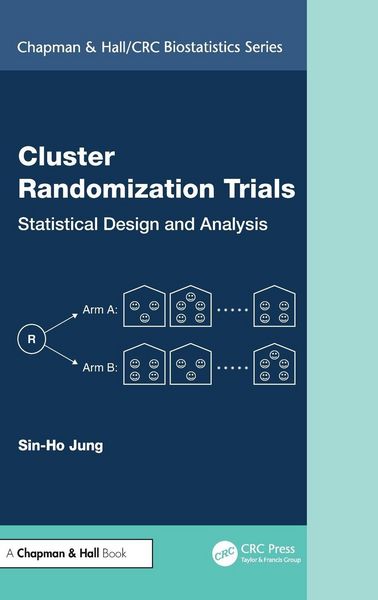
Oftentimes, small groups (called clusters) of individuals (called subunits) are randomized between treatment arms. Typically, clusters are families, classes, communities, surgeons operating patients, and so on. Such trials are called cluster randomization trials (CRTs). The subunits in each cluster share common frailties so that their outcomes tend to be positively correlated. Since clusters are independent, the data in two arms are independent in CRTs.
In a clinical trial, multiple sites (such as teeth or ears) from each subject may be randomized between different treatment arms. In this case, the sites (subunits) of each subject (cluster) share common genetic, physiological, or environmental characteristics so that their observations tend to be positively correlated. This kind of trials are called subunit randomization trials (SRTs). In SRTs, dependency exists both within and between treatment arms.
Individually randomized group treatment (IRGT) trials are composite of traditional independent subject randomization and CRTs. In an IRGT trial, the control arm is to treat patients individually, whereas the experimental arm is to treat patients using a group training, education, or treatment to increase the treatment effect by close interactions among patients. As a result, the outcome data of the control arm are independent as in traditional trials, but those in the experimental arm are correlated within each group (cluster) as in CRTs. Hence, two arms in IRGT trials have different dependency structures. Unlike standard CRTs, clusters of IRGT trials are usually organized after randomization. But statistically, they have identical statistical issues between the two types of trials, i.e., accounting for the dependency within each cluster.
Although this book is entitled Cluster Randomization Trials, it covers all three types of trials (i.e., CRTs, SRTs, and IRGT trials) resulting in clustered data. For outcome variables of binary, continuous, and time-to-event types, we investigate generalized estimating equation type statistical tests and their sample size formulas. Also presented are random number generation algorithms for different types of outcome variables and randomization methods. The methods are discussed in terms of clinical trials, but can be used to design and analyze any types of experiments involving clustered data. This book also discusses statistical methods for various types of biomarker studies, including ROC methods, with clustered data.
Key Features:
- Includes extensive statistical tests and their sample size formulas for various types of clinical trials resulting in clustered data.
- Handles different variable types of endpoints separately.
- Discusses algorithms to generate clustered binary and survival data that are useful for simulations.
- Covers statistical tests and sample size formulas for medical tests with clustered data.
Noch keine Bewertungen vorhanden
Verfassen Sie die erste Bewertung zu diesem Artikel
Helfen Sie anderen Kundinnen und Kunden durch Ihre Meinung.
Kurze Frage zu unserer Seite
Vielen Dank für dein Feedback
Wir nutzen dein Feedback, um unsere Produktseiten zu verbessern. Bitte habe Verständnis, dass wir dir keine Rückmeldung geben können. Falls du Kontakt mit uns aufnehmen möchtest, kannst du dich aber gerne an unseren Kund*innenservice wenden.
zum Kundenservice