Gutscheinbedingungen

**Gültig vom 24.08.2026 bis 26.08.2026 | Gültig für nicht preisgebundene fremdsprachige Bücher | Einzelne Artikel können ausgeschlossen sein | Online auf www.bücher.de einlösbar | Click & Collect nur mit Online-Zahlung (Paypal/Kreditkarte) vorab | Nicht kombinierbar mit anderen Gutscheinen oder Preisaktionen | Nur einmal pro Einkauf einlösbar | Gutschein wird auf max. 500€ Bestellwert angerechnet | Keine Barauszahlung | Nicht gültig für Versandkosten und Services

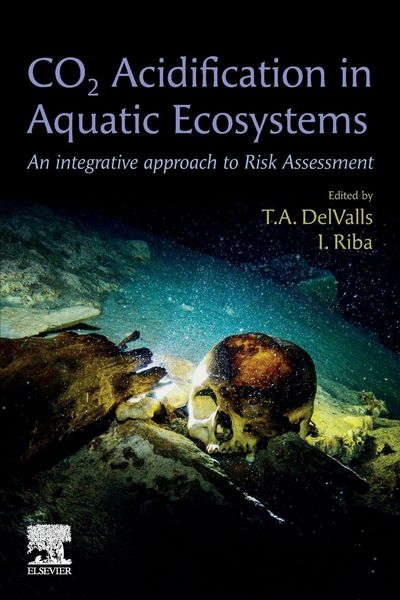
  • Produktbild: CO2 Acidification in Aquatic Ecosystems
  • Produktbild: CO2 Acidification in Aquatic Ecosystems

CO2 Acidification in Aquatic Ecosystems An Integrative Approach to Risk Assessment

179,99 €

inkl. gesetzl. MwSt., Versandkostenfrei


Beschreibung

Produktdetails

Einband

Taschenbuch

Erscheinungsdatum

20.06.2022

Herausgeber

T. A. Del Valls + weitere

Verlag

Elsevier Science & Technology

Seitenzahl

324

Maße (L/B/H)

22,9/15,2/1,7 cm

Gewicht

436 g

Sprache

Englisch

ISBN

978-0-12-823552-2

Beschreibung

Portrait

As internationally known Researcher at Environmental Science and Technology, Dr DelValls has made an important contribution to the assessment of environmental impact in aquatic ecosystems (mainly at coastal and marine ecosystems) under different research initiatives. He has more than 200 peer-reviewed research publications included in JCR/SCI (Web of Science, ISI). He has an H-index of 41 (Scopus) and higher than 40 at Google Scholar (46). He has coordinated and leadered more than 50 research and academic projects externally funded either by public and private institutions. He has over 25 years' experience in coordinating international and national research programs across a number of scientific disciplines. He has supervised more than 60 Master students, 30 Doctoral students and 15 Postdoctoral fellows from more than 20 different countries.

Dra. Riba has made an important contribution to the assessment of environmental impact in aquatic ecosystems under different research initiatives. She has more than 100 peer-reviewed research publications included in JCR/SCI (Web of Science, ISI). She has an H-index of 27 (Scopus) and 29 at Google Scholar. She has coordinated and leadered more than 10 research and academic projects externally funded either by public and private institutions.She has over 15 years' experience in coordinating international and national research programs across a number of scientific disciplines. She has supervised more than 30 Master students, 12 Doctoral students and 10 Postdoctoral fellows from more than 20 different countries.

Produktdetails

Einband

Taschenbuch

Erscheinungsdatum

20.06.2022

Herausgeber

Verlag

Elsevier Science & Technology

Seitenzahl

324

Maße (L/B/H)

22,9/15,2/1,7 cm

Gewicht

436 g

Sprache

Englisch

ISBN

978-0-12-823552-2

EU-Ansprechpartner

Zeitfracht Medien GmbH
Ferdinand-Jühlke-Straße 7|99095|Erfurt|DE
produktsicherheit@zeitfracht.de

Herstelleradresse

Elsevier Science & Technology
125 London Wall|EC2Y 5AS|London|GB
tradeorders@elsevier.com

Noch keine Bewertungen vorhanden

Verfassen Sie die erste Bewertung zu diesem Artikel

Helfen Sie anderen Kundinnen und Kunden durch Ihre Meinung.

Kundinnen und Kunden meinen

Bewertungen (0)

Die Leseprobe wird geladen.
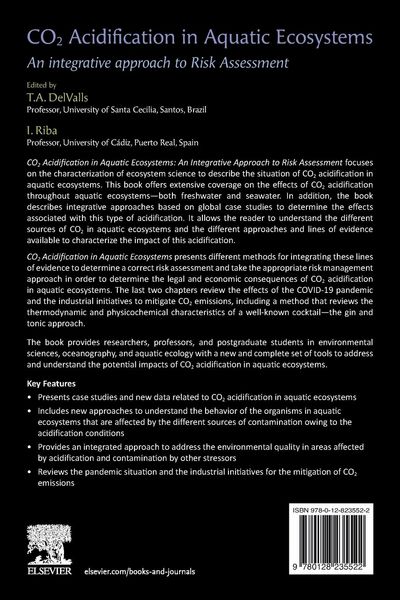
  • Produktbild: CO2 Acidification in Aquatic Ecosystems
  • Produktbild: CO2 Acidification in Aquatic Ecosystems
  • 1. Sources of CO2 acidification in aquatic ecosystems, natural versus anthropogenic
    2. Risk Assessment of CO2 acidification in aquatic ecosystems based on a weight of evidence approach
    3. Using the Chemical Line of Evidences to address the acidification
    4. The use of toxicity tests to address the impact of acidification in aquatic ecosystems
    5. Addressing the effects of CO2 acidification under 'in situ' conditions. Laboratory against field surveys
    6. Integrating causes and effects in CO2 acidification
    7. Legal and Economical consequences of anthropogenic CO2 acidification
    8. The consequence of CO2 acidification in the harmful effects of emergent contaminants: illicit drugs, microplastics, etc
    9. Plasticity, adaptation and other mechanisms using by organisms to live with CO2 acidification in aquatic ecosystems
    10. Advance in studies of CO2 acidification in fresh water ecosystems: sources, impacts, etc.
    11. Estimating the impact of CO2 acidification in a very sensible and complex system: The Cenotes, Yucatán, Mexico