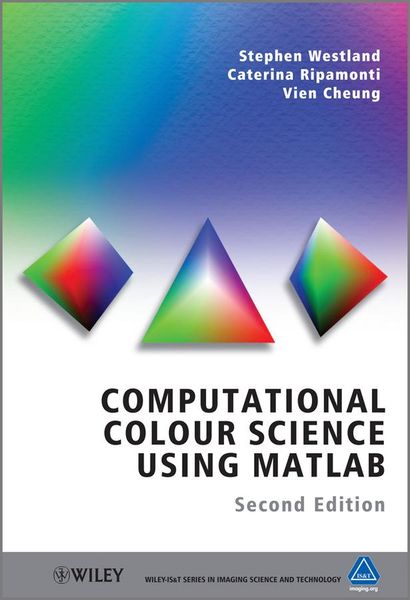
Computational Colour Science Using MATLAB
152,99 €
inkl. gesetzl. MwSt.,
Beschreibung
Produktdetails
Einband
Gebundene Ausgabe
Erscheinungsdatum
20.08.2012
Verlag
John Wiley & Sons IncSeitenzahl
240
Maße (L/B/H)
25,2/17,2/1,8 cm
Gewicht
604 g
Auflage
2nd edition
Sprache
Englisch
ISBN
978-0-470-66569-5
Computational Colour Science Using MATLAB 2nd Edition offers a practical, problem-based approach to colour physics. The book focuses on the key issues encountered in modern colour engineering, including efficient representation of colour information, Fourier analysis of reflectance spectra and advanced colorimetric computation. Emphasis is placed on the practical applications rather than the techniques themselves, with material structured around key topics. These topics include colour calibration of visual displays, computer recipe prediction and models for colour-appearance prediction.
Each topic is carefully introduced at three levels to aid student understanding. First, theoretical ideas and background information are discussed, then explanations of mathematical solutions follow and finally practical solutions are presented using MATLAB. The content includes:
- A compendium of equations and numerical data required by the modern colour and imaging scientist.
- Numerous examples of solutions and algorithms for a wide-range of computational problems in colour science.
- Example scripts using the MATLAB programming language.
This 2nd edition contains substantial new and revised material, including three innovative chapters on colour imaging, psychophysical methods, and physiological colour spaces; the MATLAB toolbox has been extended with a professional, optimized, toolbox to go alongside the current teaching toolbox; and a java toolbox has been added which will interest users who are writing web applications and/or applets or mobile phone applications.
Computational Colour Science Using MATLAB 2nd Edition is an invaluable resource for students taking courses in colour science, colour chemistry and colour physics as well as technicians and researchers working in the area. In addition, it acts a useful reference for professionals and researchers working in colour dependent industries such as textiles, paints, print & electronic imaging.
Review from First Edition:
"...highly recommended as a concise introduction to the practicalities of colour science..." (Color Technology, 2004)
Noch keine Bewertungen vorhanden
Verfassen Sie die erste Bewertung zu diesem Artikel
Helfen Sie anderen Kundinnen und Kunden durch Ihre Meinung.
Kurze Frage zu unserer Seite
Vielen Dank für dein Feedback
Wir nutzen dein Feedback, um unsere Produktseiten zu verbessern. Bitte habe Verständnis, dass wir dir keine Rückmeldung geben können. Falls du Kontakt mit uns aufnehmen möchtest, kannst du dich aber gerne an unseren Kund*innenservice wenden.
zum Kundenservice