KI-Beratung Beta

  • Produktbild: Computational Financial Mathematics using MATHEMATICA®
  • Produktbild: Computational Financial Mathematics using MATHEMATICA®

Computational Financial Mathematics using MATHEMATICA® Optimal Trading in Stocks and Options

79,99 €

inkl. gesetzl. MwSt., Versandkostenfrei


Beschreibung

Given the explosion of interest in mathematical methods for solving problems in finance and trading, a great deal of research and development is taking place in universities, large brokerage firms, and in the supporting trading software industry. Mathematical advances have been made both analytically...

Beschreibung

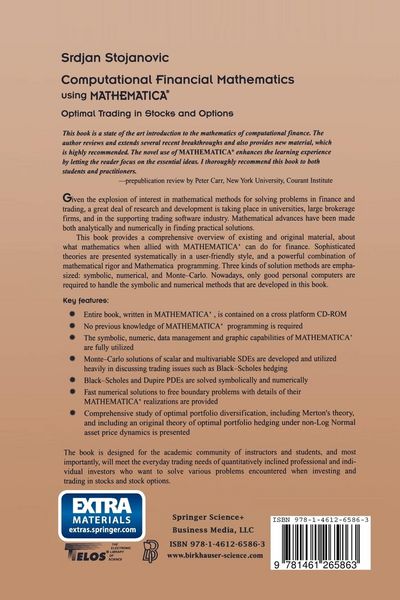
Given the explosion of interest in mathematical methods for solving problems in finance and trading, a great deal of research and development is taking place in universities, large brokerage firms, and in the supporting trading software industry. Mathematical advances have been made both analytically and numerically in finding practical solutions.

This book provides a comprehensive overview of existing and original material, about what mathematics when allied with Mathematica can do for finance. Sophisticated theories are presented systematically in a user-friendly style, and a powerful combination of mathematical rigor and Mathematica programming. Three kinds of solution methods are emphasized: symbolic, numerical, and Monte-- Carlo. Nowadays, only good personal computers are required to handle the symbolic and numerical methods that are developed in this book.

Key features: * No previous knowledge of Mathematica programming is required * The symbolic, numeric, data management and graphic capabilities of Mathematica are fully utilized * Monte--Carlo solutions of scalar and multivariable SDEs are developed and utilized heavily in discussing trading issues such as Black--Scholes hedging * Black--Scholes and Dupire PDEs are solved symbolically and numerically * Fast numerical solutions to free boundary problems with details of their Mathematica realizations are provided * Comprehensive study of optimal portfolio diversification, including an original theory of optimal portfolio hedging under non-Log-Normal asset price dynamics is presented

The book is designed for the academic community of instructors and students, and most importantly, will meet the everyday trading needs of quantitatively inclined professional and individual investors.

Rezension

"Stojanovic offers an excellent, user-friendly presentation of advanced mathematical techniques and Mathematica programming for solving problems in finance and trading. He demonstrates the value of probability, mathematical statistics, calculus of variations, and optimal control of stochastic, ordinary and partial differential equations to the study of market analysis. Solutions are computed symbolically, numerically, or by means of Monte-Carlo simulations.... A very useful and valuable book for researchers, students, professionals, and individual investors."  
—Choice

"It is an innovative approach and is very useful for students and practitioners in finance to learn how to use mathematics for investment analysis."  
—Mathematical Reviews

"This book is a state-of-the-art introduction to the mathematics of computational finance. The author reviews and extends several recent breakthroughs and also provides new material, which is highly recommended. The novel use of Mathematica enhances the learning experience by letting the reader focus on the essential ideas. I thoroughly recommend this book to both students and practitioners."  
—Peter Carr, Courant Institute, New York University

Produktdetails

Einband

Taschenbuch

Erscheinungsdatum

17.05.2013

Abbildungen

XI, 481 p.

Verlag Birkhäuser Boston

Produktdetails

Einband

Taschenbuch

Erscheinungsdatum

17.05.2013

Abbildungen

XI, 481 p.

Verlag Birkhäuser Boston
Seitenzahl

481

Maße (L/B/H)

23,5/15,5/2,7 cm

Gewicht

744 g

Auflage

Softcover reprint of the original 1st edition 2003

Sprache

Englisch

ISBN

978-1-4612-6586-3

Herstelleradresse

Springer-Verlag GmbH
Tiergartenstr. 17
69121 Heidelberg
DE

Email: ProductSafety@springernature.com

Noch keine Bewertungen vorhanden

Verfassen Sie die erste Bewertung zu diesem Artikel

Helfen Sie anderen Kundinnen und Kunden durch Ihre Meinung.

Kundinnen und Kunden meinen

Bewertungen (0)

  • Produktbild: Computational Financial Mathematics using MATHEMATICA®
  • Produktbild: Computational Financial Mathematics using MATHEMATICA®
  • 0 Introduction.- 0.1 Audience, Highlights, Agenda.- 0.2 Software Installation.- 0.3 Acknowledgments.- Chapter1 Cash Account Evolution.- 1.1 Symbolic Solutions of ODEs.- 1.2 Numerical Solutions of ODEs.- 2 Stock Price Evolution.- 2.1 What are Stocks?.- 2.2 Stock Price Modeling: Stochastic Differential Equations.- 2.3 Itô Calculus.- 2.4 Multivariate and Symbolic Itô Calculus.- 2.5 Relationship Between SDEs and PDEs.- 3 European Style Stock Options.- 3.1 What Are Stock Options?.- 3.2 Black-Scholes PDE and Hedging.- 3.3 Solving Black-Scholes PDE Symbolically.- 3.4 Generalized Black-Scholes Formulas: Time-Dependent Data.- 4 Stock Market Statistics.- 4.1 Remarks.- 4.2 Stock Market Data Import and Manipulation.- 4.3 Volatility Estimates: Scalar Case.- 4.4 Appreciation Rate Estimates: Scalar Case.- 4.5 Statistical Experiments: Bayesian and Non-Bayesian.- 4.6 Vector Basic Price Model Statistics.- 4.7 Dynamic Statistics: Filtering of Conditional Gaussian Processes.- 5 Implied Volatility for European Options.- 5.1 Remarks.- 5.2 Option Market Data.- 5.3 Black-Scholes Theory vs. Market Data: Implied Volatility.- 5.4 Numerical PDEs, Optimal Control, and Implied Volatility.- 6 American Style Stock Options.- 6.1 Remarks.- 6.2 American Options and Obstacle Problems.- 6.3 General Implied Volatility for American Options.- 7 Optimal Portfolio Rules.- 7.1 Remarks.- 7.2 Utility of Wealth.- 7.3 Merton’s Optimal Portfolio Rule Derived and Implemented.- 7.4 Portfolio Rules under Appreciation Rate Uncertainty.- 7.5 Portfolio Optimization under Equality Constraints.- 7.6 Portfolio Optimization under Inequality Constraints.- 8 Advanced Trading Strategies.- 8.1 Remarks.- 8.2 Reduced Monge—Ampere PDEs of Advanced Portfolio Hedging.- 8.3 Hypoelliptic Obstacle Problems in Optimal MomentumTrading.