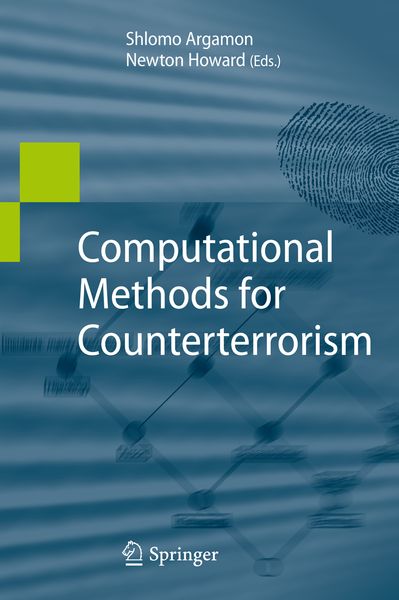
Computational Methods for Counterterrorism
-
- Hardcover ausgewählt
- Taschenbuch
- eBook
-
Sprache:Englisch
95,99 €
UVP
106,99 €
inkl. gesetzl. MwSt.,
Beschreibung
Produktdetails
Einband
Gebundene Ausgabe
Erscheinungsdatum
15.07.2009
Abbildungen
XVIII, 306 p.
Herausgeber
Shlomo Argamon + weitereVerlag
Springer BerlinSeitenzahl
306
Maße (L/B/H)
24,1/16/2,5 cm
Gewicht
712 g
Auflage
2009
Sprache
Englisch
ISBN
978-3-642-01140-5
This book collects a wide range of the most current computational research that addresses critical issues for countering terrorism, including:
Finding, summarizing, and evaluating relevant information from large and changing data stores;
Simulating and predicting enemy acts and outcomes; and
Producing actionable intelligence by finding meaningful patterns hidden in huge amounts of noisy data.
The book’s four sections describe current research on discovering relevant information buried in vast amounts of unstructured data; extracting meaningful information from digitized documents in multiple languages; analyzing graphs and networks to shed light on adversaries’ goals and intentions; and developing software systems that enable analysts to model, simulate, and predict the effects of real-world conflicts.
The research described in this book is invaluable reading for governmental decision-makers designing new policies to counter terrorist threats, for members of the military, intelligence, and law enforcement communities devising counterterrorism strategies, and for researchers developing more effective methods for knowledge discovery in complicated and diverse datasets.
Noch keine Bewertungen vorhanden
Verfassen Sie die erste Bewertung zu diesem Artikel
Helfen Sie anderen Kundinnen und Kunden durch Ihre Meinung.
Kurze Frage zu unserer Seite
Vielen Dank für dein Feedback
Wir nutzen dein Feedback, um unsere Produktseiten zu verbessern. Bitte habe Verständnis, dass wir dir keine Rückmeldung geben können. Falls du Kontakt mit uns aufnehmen möchtest, kannst du dich aber gerne an unseren Kund*innenservice wenden.
zum Kundenservice