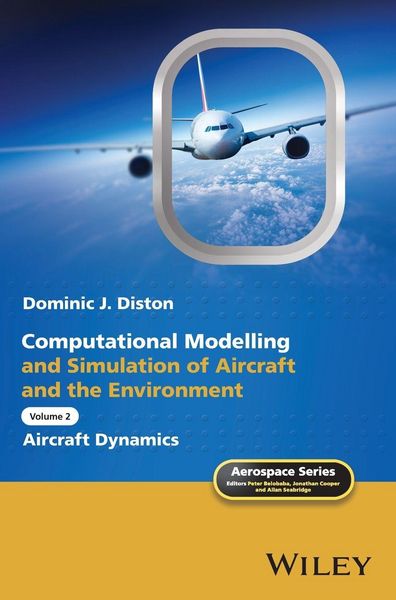
Produktbild: Computational Modelling and Simulation of Aircraft and the Environment, Volume 2
Band 2 - 12%

Computational Modelling and Simulation of Aircraft and the Environment, Volume 2

Aus der Reihe Aerospace Series (PEP)
12% sparen

69,99 € UVP 79,90 €

inkl. gesetzl. MwSt., Versandkostenfrei


Beschreibung

Produktdetails

Einband

Gebundene Ausgabe

Erscheinungsdatum

06.02.2024

Herausgeber

Peter Belobaba + weitere

Verlag

John Wiley & Sons

Seitenzahl

208

Maße (L/B/H)

24,4/17/1,3 cm

Gewicht

531 g

Auflage

1. Auflage

Sprache

Englisch

ISBN

978-0-470-68711-6

Beschreibung

Produktdetails

Einband

Gebundene Ausgabe

Erscheinungsdatum

06.02.2024

Herausgeber

Verlag

John Wiley & Sons

Seitenzahl

208

Maße (L/B/H)

24,4/17/1,3 cm

Gewicht

531 g

Auflage

1. Auflage

Sprache

Englisch

ISBN

978-0-470-68711-6

EU-Ansprechpartner

Kolibri 360 GmbH
Ettore-Bugatti-Straße 6-14
51149 Köln
DE
produktsicherheit@kolibri360.de

Herstelleradresse

Wiley & Sons
1 Oldlands Way
PO22 9NQ Bognor Regis
GB
trade@wiley.com

Noch keine Bewertungen vorhanden

Verfassen Sie die erste Bewertung zu diesem Artikel

Helfen Sie anderen Kundinnen und Kunden durch Ihre Meinung.

Kundinnen und Kunden meinen

Bewertungen (0)

Die Leseprobe wird geladen.
  • Produktbild: Computational Modelling and Simulation of Aircraft and the Environment, Volume 2
  • Preface xi
     
    Aerospace Series Preface xiii
     
    1 A Simple Flight Model 1
     
    1.1 Introduction 1
     
    1.1.1 General Introduction to Volume 2 1
     
    1.1.2 What Chapter 1 Includes 1
     
    1.1.3 What Chapter 1 Excludes 2
     
    1.1.4 Overall Aim 2
     
    1.2 Flight Path 2
     
    1.3 Flight Environment
     
    1.4 Simple Propulsion Model 6
     
    1.4.1 Reference Parameters 6
     
    1.4.2 Simple Jet Engine Performance 7
     
    1.4.3 'Better' Jet Engine Performance 8
     
    1.4.4 Simple Jet Engine Dynamics 10
     
    1.5 Simple Aerodynamic Model 10
     
    1.5.1 Idealised Aircraft 10
     
    1.5.2 Idealised Wing 11
     
    1.5.3 Wing/Tail Combination 13
     
    1.5.4 Lift Distribution 15
     
    1.5.5 Adding Flight Controls 18
     
    1.6 Airspeed Definitions 20
     
    1.7 Flight Model Architecture 21
     
    2 Equations of Motion 25
     
    2.1 Introduction 25
     
    2.1.1 The Problem with Equations of Motion 25
     
    2.1.2 What Chapter 2 Includes 25
     
    2.1.3 What Chapter 2 Excludes 26
     
    2.1.4 Overall Aim 26
     
    2.2 Spatial Reference Model 26
     
    2.2.1 Generic Reference Frames 26
     
    2.2.2 Rotating Reference Frames 28
     
    2.2.3 Elementary Rotations 29
     
    2.2.4 Reference Frames for Position and Orientation 30
     
    2.2.5 Reference Frame for Flight Path 32
     
    2.2.6 Airspeed and Airstream Direction 33
     
    2.3 Aircraft Dynamics 34
     
    2.3.1 Mass Properties 34
     
    2.3.2 Flight Parameters 35
     
    2.3.3 Dynamic Equations of Motion 36
     
    2.4 Aircraft Kinematics 39
     
    2.4.1 Aircraft Position 39
     
    2.4.2 Quaternions 40
     
    2.4.3 Kinematic Equations of Motion 41
     
    2.5 Initialisation 42
     
    2.5.1 Balancing Forces 42
     
    2.5.2 Typical Flight Conditions 44
     
    2.5.3 Finding Aircraft Flight Parameters for Equilibrium 45
     
    2.6 Linearisation 48
     
    2.6.1 Linearisation of Dynamic Equations of Motion 48
     
    2.6.2 Linearisation of Kinematic Equations of Motion 49
     
    2.6.3 Linearisation of Aerodynamic Forces and Moments 50
     
    2.6.4 Linearisation of Propulsive Forces and Moments 51
     
    2.6.5 Linearisation of Gravitational Forces and Moments 51
     
    2.6.6 The Complete Linearised System of Equations 52
     
    3 Fixed-Wing Aerodynamics 55
     
    3.1 Introduction 55
     
    3.1.1 Fixed Wings and Aerodynamics 55
     
    3.1.2 What Chapter 3 Includes 55
     
    3.1.3 What Chapter 3 Excludes 56
     
    3.1.4 Overall Aim 56
     
    3.2 Aerodynamic Principles 56
     
    3.2.1 Aerofoils 56
     
    3.2.2 Dimensional Analysis 58
     
    3.2.3 Lift, Drag, and Pitching Moment 59
     
    3.2.4 Aerodynamic Centre 61
     
    3.2.5 Wing Geometry 63
     
    3.2.6 NACA Four-Digit Sections 64
     
    3.3 Aerodynamic Model of an Isolated Wing 66
     
    3.3.1 Aerodynamic Lift 66
     
    3.3.2 Pitching Moment 68
     
    3.3.3 Drag Force 69
     
    3.3.4 Profile Drag 69
     
    3.3.5 Induced Drag 70
     
    3.3.6 Wave Drag 73
     
    3.4 Trailing-Edge Controls 75
     
    3.4.1 Incremental Lift 75
     
    3.4.2 Incremental Drag 78
     
    3.4.3 Incremental Pitching Moment 79
     
    3.4.4 Hinge Moments 79
     
    3.5 Factors affecting Lift Generation 81
     
    3.5.1 Sideslip 81
     
    3.5.2 Aircraft Rotation 82
     
    3.5.3 Structural Flexibility 83
     
    3.5.4 Ground Effect 85
     
    3.5.5 Indicial Aerodynamics 85
     
    3.6 Lift Distribution 86
     
    3.7 Drag Distribution 89
     
    4 Longitudinal Flight 91
     
    4.1 Introduction 91
     
    4.1.1 Flight with Wings Level