KI-Beratung Beta

  • Produktbild: Computational Modelling of the Brain
  • Produktbild: Computational Modelling of the Brain
Band 1359 - 13%

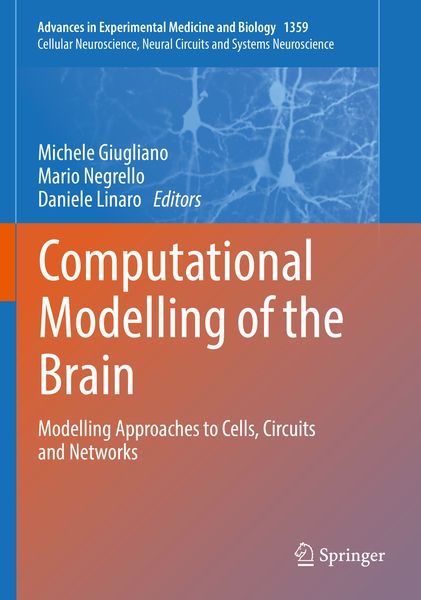
Computational Modelling of the Brain Modelling Approaches to Cells, Circuits and Networks

13% sparen

129,99 € UVP 149,79 €

inkl. gesetzl. MwSt., Versandkostenfrei


Beschreibung

Produktdetails

Einband

Taschenbuch

Erscheinungsdatum

28.04.2023

Abbildungen

XII, 359 p. 115 illus., 94 illus. in color.

Herausgeber

Michele Giugliano + weitere

Verlag

Springer

Seitenzahl

359

Maße (L/B/H)

25,4/17,8/2,1 cm

Gewicht

699 g

Auflage

23001 Auflage 1st ed. 2022

Sprache

Englisch

ISBN

978-3-030-89441-2

Beschreibung

Portrait

Michele Giugliano graduated in Electronic Engineering in 1997 at the Univ. of Genova (Italy), and received his PhD in Bioengineering and Computational Neuroscience in 2001 from the Polytechnic of Milan (Italy).

He then received an award from the Human Frontiers Science Program Organisation to pursue postdoctoral training in experimental cell electrophysiology at the Inst. of Physiology of the Univ. of Bern (Switzerland), working with Prof. Hans-Rudolf Luescher and Prof. Stefano Fusi.

In 2005, he joined as junior group leader the experimental laboratory of Prof. Henry Markram at the Brain Mind Institute of the Swiss Federal Institute of Technology of Lausanne. In 2008 he was appointed faculty at the University of Antwerpen (Belgium), taking over the Theoretical Neurobiology lab founded by Prof. Erik De Schutter and extending its scope to interdisciplinary research in experimental neuroscience and neuroengineering. During the period 2013-2015, he was also visitingscientist at the Neuroelectronics Flanders Institute at IMEC, Leuven.

From 2016 to 2019, he was full professor in Antwerp and he has served visiting academic positions at the University of Sheffield (UK). Today, since 2019, he has been Principal Investigator and lab director at the International School of Advanced Studies (SISSA) of Trieste, Italy, where he relocated his team.

Since 2008, Michele Giugliano has taught Computational Neurobiology to undergraduate and graduate students from a variety of backgrounds in Life Sciences, Biomedical Sciences, Physics, and Computer Science.

Michele Giugliano’s research activities lays at the interface among cell electrophysiology, computational neuroscience, and neurotechnology. He discovered the rapid time-scales associated to neuronal excitability in the rodent and human cortex, and pioneered the use of nanomaterials for building interfaces between artificial devices and the neural tissue.

Mario Negrello obtained a mechanical engineering degree in Brazil (1997), and later after a period in the industry (VW, 1999-2004) obtained his Masters degree (2006) and PhD (summa cum laude) in Cognitive Science at the University of Osnabrück in Germany, in 2009. At the Fraunhofer Institute in Sankt Augustin (Germany) for Intelligent Dynamics and Autonomous Systems, he researched artificial evolution of neural network controllers for autonomous robots (2007/08). This work was awarded a scholarship by the International Society of Neural Networks (INNS) to sponsor an eight-month period (2008/09) as a visiting researcher at the Computational Synthesis Lab at the Aerospace Engineering department of the Cornell University in USA (with Hod Lipson). In his first post doctoral period he acted a group leader at the Computational Neuroscience laboratory at the Okinawa Institute of Science and Technology (with Erik De Schutter). He now is assistant professor in computational neuroscience in the Erasmus Medical Center in Rotterdam, where he combines empirical research and computational models (dept. head Chris De Zeeuw). He is also head of the Neurocomputing lab in Rotterdam. Mario Negrello has published in the fields of Machine Learning, Cognitive Robotics, Artificial Life, Evolutionary Robotics, Neuroethology and Neuroscience, as well as a monograph published by Springer US in the Series Cognitive and Neural systems entitled Invariants of Behavior (2012).


Daniele Linaro received his MSc in Electronic Engineering from the Univ. of Genoa (Italy) in 2007 and a PhD in Electrical Engineering from the same university in 2011.

In the same year, he was awarded a fellowship from the Flemish Research Foundation - FWO to conduct postdoctoral work in the Laboratory of Theoretical Neurobiology and Neuroengineering at the University of Antwerp, under the supervision of Prof. Michele Giugliano, where he used dynamic-clamp to elucidate the computational capabilities of different cell types in the rodent cortex.

In 2015 he moved to the Laboratory of Cortical Development at VIB (Leuven, Belgium), under the supervision of Prof. Pierre Vanderhaeghen, where he studied the protracted electrophysiological and morphological development of human cortical neurons grafted in the rodent cortex.

Since 2014, he holds a position as Visiting Scientist at Janelia Research Campus in collaboration with the laboratory of Dr. Nelson Spruston, where he investigates the network properties of different cell types in the rodent hippocampus.

Since 2018, he is Assistant Professor in the Department of Electronics, Information Technology and Bioengineering at the Polytechnic of Milan.

Throughout his career, Daniele Linaro has always been fascinated by the computational capabilities of single neurons and has been working to bridge the gap between computational and experimental approaches to studying and modelling the rodent and human brain. 

Produktdetails

Einband

Taschenbuch

Erscheinungsdatum

28.04.2023

Abbildungen

XII, 359 p. 115 illus., 94 illus. in color.

Herausgeber

Verlag

Springer

Seitenzahl

359

Maße (L/B/H)

25,4/17,8/2,1 cm

Gewicht

699 g

Auflage

23001 Auflage 1st ed. 2022

Sprache

Englisch

ISBN

978-3-030-89441-2

Herstelleradresse

Springer-Verlag KG
Sachsenplatz 4-6
1201 Wien
AT

Email: ProductSafety@springernature.com

Noch keine Bewertungen vorhanden

Verfassen Sie die erste Bewertung zu diesem Artikel

Helfen Sie anderen Kundinnen und Kunden durch Ihre Meinung.

Kundinnen und Kunden meinen

Bewertungen (0)

  • Produktbild: Computational Modelling of the Brain
  • Produktbild: Computational Modelling of the Brain
  • PART I. Cellular Scale.- Chapter 1. Modelling Neurons in 3D at the Nanoscale.- Chapter 2. Modelling Dendrites and Spatially-Distributed Neuronal Membrane Properties.- Chapter 3. A User's Guide to Generalized Integrate-and-Fire Models.- Chapter 4. Neuron-glia Interactions and Brain Circuits.- Chapter 5. Short-term Synaptic Plasticity: Microscopic Modelling and (some) Computational Implications.- PART II. Molecular Scale.- Chapter 6. The Mean Field Approach for Populations of Spiking Neurons.- Chapter 7. Multidimensional Dynamical Systems with Noise.- Chapter 8. Computing Extracellular Electric Potentials from Neuronal Simulations.- Chapter 9. Bringing Anatomical Information into Neuronal Network Models.- PART III. Network Scale.- Chapter 10. Computational Concepts for Reconstructing and Simulating Brain Tissue.- Chapter 11. Reconstruction of the Hippocampus.- Chapter 12. Challenges for Place and Grid Cell Models.- Chapter 13. Whole-Brain Modelling: Past, Present, and Future.