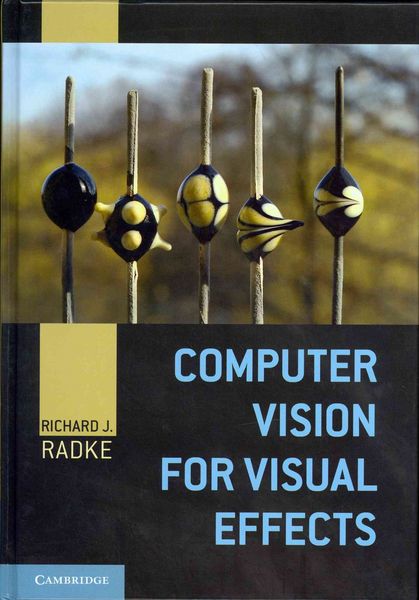
Produktbild: Computer Vision for Visual Effects

Computer Vision for Visual Effects

73,99 €

inkl. gesetzl. MwSt., Versandkostenfrei

Lieferung nach Hause

Beschreibung

Produktdetails

Einband

Gebundene Ausgabe

Erscheinungsdatum

19.11.2012

Verlag

Cambridge University Press

Seitenzahl

405

Maße (L/B/H)

26,1/18,2/3 cm

Gewicht

970 g

Sprache

Englisch

ISBN

978-0-521-76687-6

Beschreibung

Rezension

"Hollywood's achievements in visual effects have been enabled not just by advances in computer graphics, but just as much by techniques from the neighboring field of computer vision. Vision techniques such as camera tracking, 3D reconstruction, and face and body motion capture contribute to most of the visual effects shots we see today. Rich Radke's book Computer Vision for Visual Effects begins with the basics and shows how math, geometry, image processing, and scene understanding comprise these tools that create the movies. Read it and you'll understand an important part of the magic that makes the films we love."
Paul Debevec, Scientific and Engineering Academy Award Winner for Lightstage Work

Produktdetails

Einband

Gebundene Ausgabe

Erscheinungsdatum

19.11.2012

Verlag

Cambridge University Press

Seitenzahl

405

Maße (L/B/H)

26,1/18,2/3 cm

Gewicht

970 g

Sprache

Englisch

ISBN

978-0-521-76687-6

Herstelleradresse

Libri GmbH
Europaallee 1
36244 Bad Hersfeld
DE

Email: gpsr@libri.de

Kundinnen und Kunden meinen

0 Bewertungen

Informationen zu Bewertungen

Zur Abgabe einer Bewertung ist eine Anmeldung im Konto notwendig. Die Authentizität der Bewertungen wird von uns nicht überprüft. Wir behalten uns vor, Bewertungstexte, die unseren Richtlinien widersprechen, entsprechend zu kürzen oder zu löschen.

Die Bewertungen sind nach Format, Anzahl Sterne und Datum sortiert.

Verfassen Sie die erste Bewertung zu diesem Artikel

Helfen Sie anderen Kund*innen durch Ihre Meinung

Kundinnen und Kunden meinen

0 Bewertungen filtern

Die Leseprobe wird geladen.
  • Produktbild: Computer Vision for Visual Effects
  • 1. Introduction; 2. Image matting; 3. Image compositing and editing; 4. Features and matching; 5. Dense correspondence and its applications; 6. Matchmoving; 7. Motion capture; 8. Three-dimensional data acquisition; Appendix: optimization algorithms for computer vision.