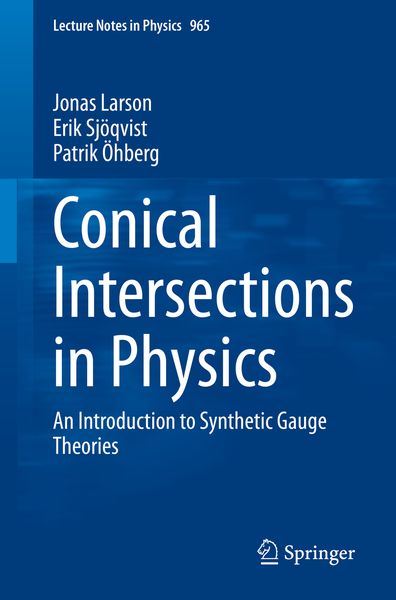
Conical Intersections in Physics An Introduction to Synthetic Gauge Theories
-
- Taschenbuch ausgewählt
- eBook
-
Sprache:Englisch
59,99 €
inkl. gesetzl. MwSt.,
Beschreibung
Produktdetails
Einband
Taschenbuch
Erscheinungsdatum
01.02.2020
Abbildungen
XIII, 160 p. 57 illus., 34 illus. in color.
Verlag
SpringerSeitenzahl
160
Maße (L/B/H)
23,5/15,5/1 cm
Gewicht
277 g
Auflage
1st ed. 2020
Sprache
Englisch
ISBN
978-3-030-34881-6
This concise book introduces and discusses the basic theory of conical intersections with applications in atomic, molecular and condensed matter physics.
Conical intersections are linked to the energy of quantum systems. They can occur in any physical system characterized by both slow and fast degrees of freedom - such as e.g. the fast electrons and slow nuclei of a vibrating and rotating molecule - and are important when studying the evolution of quantum systems controlled by classical parameters. Furthermore, they play a relevant role for understanding the topological properties of condensed matter systems.
Conical intersections are associated with many interesting features, such as a breakdown of the Born-Oppenheimer approximation and the appearance of nontrivial artificial gauge structures, similar to the Aharonov-Bohm effect.
Some applications presented in this book include
- Molecular Systems: some molecules in nonlinear nuclear configurations undergo Jahn-Teller distortions under which the molecule lower their symmetry if the electronic states belong to a degenerate irreducible representation of the molecular point group.
- Solid State Physics: different types of Berry phases associated with conical intersections can be used to detect topologically nontrivial states of matter, such as topological insulators, Weyl semi-metals, as well as Majorana fermions in superconductors.
- Cold Atoms: the motion of cold atoms in slowly varying inhomogeneous laser fields is governed by artificial gauge fields that arise when averaging over the fast internal degrees of freedom of the atoms. These gauge fields can be Abelian or non-Abelian, which opens up the possibility to create analogs to various relativistic effects at low speed.
Noch keine Bewertungen vorhanden
Verfassen Sie die erste Bewertung zu diesem Artikel
Helfen Sie anderen Kundinnen und Kunden durch Ihre Meinung.
Kurze Frage zu unserer Seite
Vielen Dank für dein Feedback
Wir nutzen dein Feedback, um unsere Produktseiten zu verbessern. Bitte habe Verständnis, dass wir dir keine Rückmeldung geben können. Falls du Kontakt mit uns aufnehmen möchtest, kannst du dich aber gerne an unseren Kund*innenservice wenden.
zum Kundenservice