
Control Synthesis for Semi-Markovian Switching Systems
-
- Hardcover ausgewählt
- Taschenbuch
- eBook
-
Sprache:Englisch
139,99 €
UVP
160,49 €
inkl. gesetzl. MwSt.,
Beschreibung
Produktdetails
Einband
Gebundene Ausgabe
Erscheinungsdatum
08.03.2023
Abbildungen
XIII, 222 p. 62 illus., 54 illus. in color.
Verlag
Springer SingaporeSeitenzahl
222
Maße (L/B/H)
24,1/16/1,9 cm
Gewicht
524 g
Auflage
2023
Sprache
Englisch
ISBN
978-981-9903-16-0
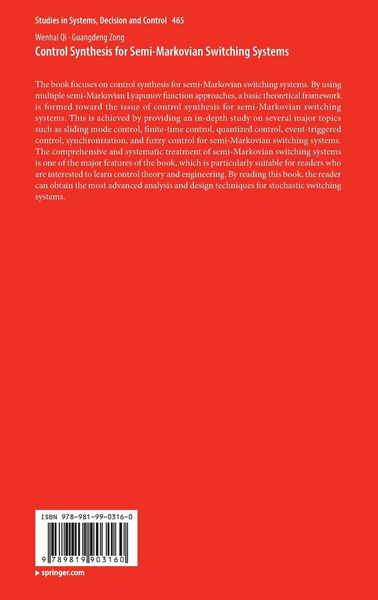
The book focuses on control synthesis for semi-Markovian switching systems. By using multiple semi-Markovian Lyapunov function approaches, a basic theoretical framework is formed toward the issue of control synthesis for semi-Markovian switching systems. This is achieved by providing an in-depth study on several major topics such as sliding mode control, finite-time control, quantized control, event-triggered control, synchronization, and fuzzy control for semi-Markovian switching systems. The comprehensive and systematic treatment of semi-Markovian switching systems is one of the major features of the book, which is particularly suitable for readers who are interested to learn control theory and engineering. By reading this book, the reader can obtain the most advanced analysis and design techniques for stochastic switching systems.
Noch keine Bewertungen vorhanden
Verfassen Sie die erste Bewertung zu diesem Artikel
Helfen Sie anderen Kundinnen und Kunden durch Ihre Meinung.
Kurze Frage zu unserer Seite
Vielen Dank für dein Feedback
Wir nutzen dein Feedback, um unsere Produktseiten zu verbessern. Bitte habe Verständnis, dass wir dir keine Rückmeldung geben können. Falls du Kontakt mit uns aufnehmen möchtest, kannst du dich aber gerne an unseren Kund*innenservice wenden.
zum Kundenservice