
Converting STEM into STEAM Programs Methods and Examples from and for Education
-
- Hardcover
- Taschenbuch ausgewählt
- eBook
-
Sprache:Englisch
157,99 €
inkl. gesetzl. MwSt.,
Beschreibung
Produktdetails
Einband
Taschenbuch
Erscheinungsdatum
26.08.2021
Abbildungen
XVI, 305 p. 126 illus.
Herausgeber
Arthur J. Stewart + weitereVerlag
SpringerSeitenzahl
305
Maße (L/B/H)
23,5/15,5/1,8 cm
Gewicht
493 g
Auflage
21001 Auflage 1st ed. 2019
Sprache
Englisch
ISBN
978-3-030-25103-1
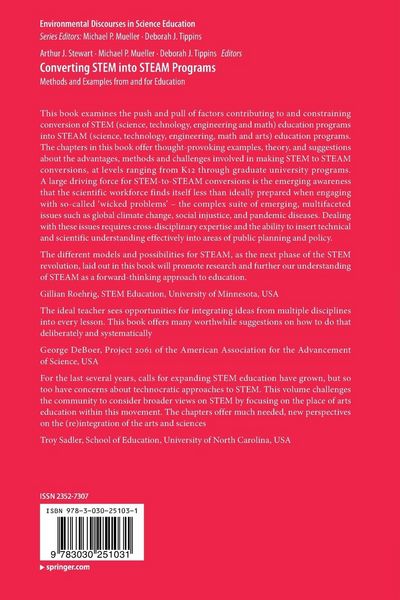
This book examines the push and pull of factors contributing to and constraining conversion of STEM (science, technology, engineering and math) education programs into STEAM (science, technology, engineering, math and arts) education programs. The chapters in this book offer thought-provoking examples, theory, and suggestions about the advantages, methods and challenges involved in making STEM to STEAM conversions, at levels ranging from K12 through graduate university programs. A large driving force for STEM-to-STEAM conversions is the emerging awareness that the scientific workforce finds itself less than ideally prepared when engaging with so-called ‘wicked problems’ – the complex suite of emerging, multifaceted issues such as global climate change, social injustice, and pandemic diseases. Dealing with these issues requires cross-disciplinary expertise and the ability to insert technical and scientific understanding effectively into areas of public planning and policy.
The different models and possibilities for STEAM, as the next phase of the STEM revolution, laid out in this book will promote research and further our understanding of STEAM as a forward-thinking approach to education.
Gillian Roehrig,
STEM Education, University of Minnesota, USA
The ideal teacher sees opportunities for integrating ideas from multiple disciplines into every lesson. This book offers many worthwhile suggestions on how to do that deliberately and systematically
George DeBoer,
Project 2061 of the American Association for the Advancement of Science, USA
For the last several years, calls for expanding STEM education have grown, but so too have concerns about technocratic approaches to STEM. This volume challenges the community to consider broader views on STEM by focusing on the place of arts education within this movement. The chapters offer much needed, new perspectives on the (re)integration of the arts and sciences
Troy Sadler,
School of Education, University of North Carolina, USA
Noch keine Bewertungen vorhanden
Verfassen Sie die erste Bewertung zu diesem Artikel
Helfen Sie anderen Kundinnen und Kunden durch Ihre Meinung.
Kurze Frage zu unserer Seite
Vielen Dank für dein Feedback
Wir nutzen dein Feedback, um unsere Produktseiten zu verbessern. Bitte habe Verständnis, dass wir dir keine Rückmeldung geben können. Falls du Kontakt mit uns aufnehmen möchtest, kannst du dich aber gerne an unseren Kund*innenservice wenden.
zum Kundenservice