• Produktbild: Coping with Hunger and Shortage under German Occupation in World War II
  • Produktbild: Coping with Hunger and Shortage under German Occupation in World War II
- 10%

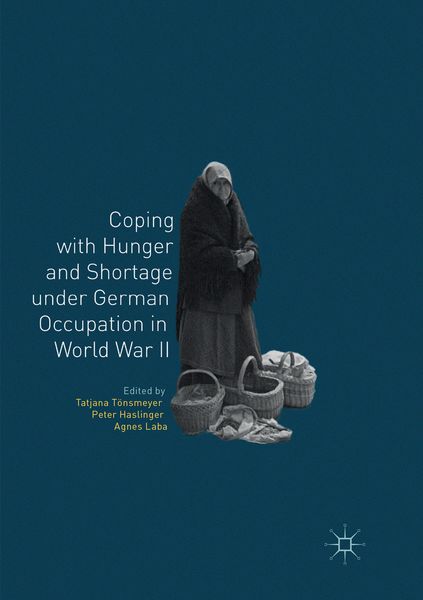
Coping with Hunger and Shortage under German Occupation in World War II

10% sparen

133,99 € UVP 149,79 €

inkl. gesetzl. MwSt., Versandkostenfrei

Lieferung nach Hause

Beschreibung

Produktdetails

Einband

Taschenbuch

Erscheinungsdatum

30.01.2019

Abbildungen

XIX, 4 illus., schwarz-weiss Illustrationen

Herausgeber

Tatjana Tönsmeyer + weitere

Verlag

Springer

Seitenzahl

319

Maße (L/B/H)

21/14,8/1,9 cm

Gewicht

445 g

Auflage

Softcover reprint of the original 1st ed. 2018

Sprache

Englisch

ISBN

978-3-030-08462-2

Beschreibung

Portrait

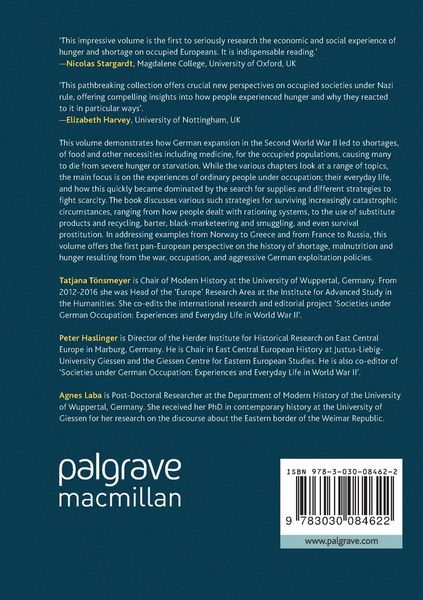
Tatjana Tönsmeyer is Chair of Modern History at the University of Wuppertal, Germany. From 2012-2016 she was Head of the 'Europe' Research Area at the Institute for Advanced Study in the Humanities. She co-edits the international research and editorial project 'Societies under German Occupation: Experiences and Everyday Life in World War II'.

Peter Haslinger is Director of the Herder Institute for Historical Research on East Central Europe in Marburg, Germany. He is Chair in East Central European History at Justus-Liebig-University Giessen and the Giessen Centre for Eastern European Studies. He is also co-editor of 'Societies under German Occupation: Experiences and Everyday Life in World War II'. 

Agnes Laba is Post-Doctoral Researcher at the Department of Modern History of the University of Wuppertal. She received her PhD in contemporary history at the University of Giessen for her research on the discourse about the Eastern border of the Weimar Republic.

Produktdetails

Einband

Taschenbuch

Erscheinungsdatum

30.01.2019

Abbildungen

XIX, 4 illus., schwarz-weiss Illustrationen

Herausgeber

Verlag

Springer

Seitenzahl

319

Maße (L/B/H)

21/14,8/1,9 cm

Gewicht

445 g

Auflage

Softcover reprint of the original 1st ed. 2018

Sprache

Englisch

ISBN

978-3-030-08462-2

Herstelleradresse

Springer Nature c/o IBS
Benzstrasse 21
48619 Heek
DE

Email: Tanja.Keller@springer.com

Kundinnen und Kunden meinen

0 Bewertungen

Informationen zu Bewertungen

Zur Abgabe einer Bewertung ist eine Anmeldung im Konto notwendig. Die Authentizität der Bewertungen wird von uns nicht überprüft. Wir behalten uns vor, Bewertungstexte, die unseren Richtlinien widersprechen, entsprechend zu kürzen oder zu löschen.

Die Bewertungen sind nach Format, Anzahl Sterne und Datum sortiert.

Verfassen Sie die erste Bewertung zu diesem Artikel

Helfen Sie anderen Kund*innen durch Ihre Meinung

Kundinnen und Kunden meinen

0 Bewertungen filtern

  • Produktbild: Coping with Hunger and Shortage under German Occupation in World War II
  • Produktbild: Coping with Hunger and Shortage under German Occupation in World War II
  • Introduction: Supply Situations: Nazi Policies of Exploitation and Economies of Shortage of Occupied Societies during World War II; Tatjana Tönsmeyer.- Part I: Economies of Scarcity and “Ersatz” Site.- Black market in the General Government 1939-1945: Survival strategy or (un)official economy?; Jerzy Kochanowski.- Economies of Scarcity in Belarusian Villages During the Second World War. How New Findings from Oral History Projects put a Perpetrator Centered Historiography in Perspective; Tatsiana Kasataya and Aliaksandr Smalianchuk.- Supplies under pressure. Survival in a fully rationed society: Experiences, cases and innovation in rural and urban regions in occupied Norway; Guri Hjeltnes.- “The Black market is a crime against community”: the failure of the Vichy Government to create an egalitarian distribution and the growth of the black market in France during the German Occupation (1940-1944); Fabrice Grenard.- The black market in occupied Italy and the approach of Italian and German authorities: 1943 – 45; Alessandro Salvador and Jacopo Calussi.- Bones of Contention: The Nazi Recycling Project in Germany and France during the Second World War; Heike Weber and Chad Denton.- Part II: Coping Strategies and Creating Privileges.- Between employer and self-organisation: Belgian workers and miners coping with food shortages under German occupation (1940-44); Dirk Luyten.- “Dem tschechischen Arbeiter das Fressen geben”. Factory canteens in the “Protectorate of Bohemia and Moravia”; Jaromír Balcar.- “With the hope of a piece of sausage or a mug of beer” – Writing a History of Survival Sex in Occupied Europe; Maren Röger.- Part III: Vulnerabilities: At the Bottom of the Supply Pyramid.- Famine in Occupied Greece. On the Particular Role of the Elderly and the Infirm in a Starving Society; Violetta Hionidou.- Food, Money and Barter in the Lvov Ghetto, Eastern Galicia; Natalia Aleksiun.- The North Caucasus and German Exploitation Policies in World War II: Everyday Life Experience of Children during the Occupation; Irina Rebrova and Elena Strekalova.- ‘…have not received any deliveries of potatoes for quite some time…’. Food supply and acquisition in the ghettos of Vilnius and Kaunas; Joachim Tauber.- Fighting Vulnerability: Child-feeding Initiatives during the Dutch Hunger Winter; Ingrid de Zwarte.- Index