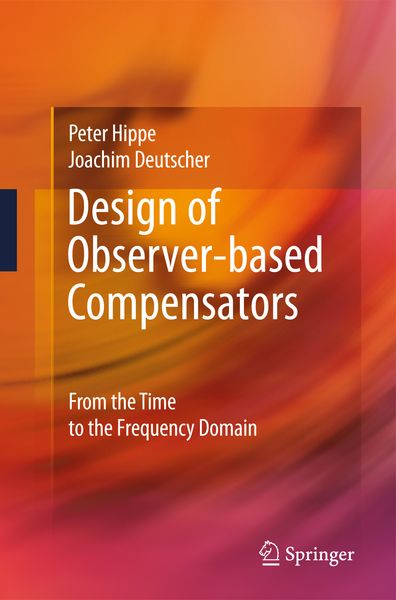
Design of Observer-based Compensators From the Time to the Frequency Domain
-
- Hardcover
- Taschenbuch ausgewählt
-
Sprache:Englisch
139,99 €
UVP
160,49 €
inkl. gesetzl. MwSt.,
Beschreibung
Produktdetails
Einband
Taschenbuch
Erscheinungsdatum
13.10.2010
Abbildungen
XIII, 285 p.
Verlag
Springer LondonSeitenzahl
285
Maße (L/B/H)
23,5/15,5/1,7 cm
Gewicht
458 g
Auflage
Softcover reprint of hardcover 1st ed. 2009
Sprache
Englisch
ISBN
978-1-84996-849-2
Design of Observer-based Compensators
facilitates and adds transparency to design in the frequency domain which is not as well-established among control engineers as time domain design. The presentation of the design procedures starts with a review of the time domain results; therefore, the book also provides quick access to state space methods for control system design.
Frequency domain design of observer-based compensators of all orders is covered. The design of decoupling and disturbance rejecting controllers is presented, and solutions are given to the linear quadratic and the model matching problems. The pole assignment design is facilitated by a new parametric approach in the frequency domain. Anti-windup control is also investigated in the framework of the polynomial approach. The discrete-time results for disturbance rejection and linear quadratic control are also presented.
The book contains worked examples that can easily be reproduced by the reader, and the results are illustrated by simulations.
Noch keine Bewertungen vorhanden
Verfassen Sie die erste Bewertung zu diesem Artikel
Helfen Sie anderen Kundinnen und Kunden durch Ihre Meinung.
Kurze Frage zu unserer Seite
Vielen Dank für dein Feedback
Wir nutzen dein Feedback, um unsere Produktseiten zu verbessern. Bitte habe Verständnis, dass wir dir keine Rückmeldung geben können. Falls du Kontakt mit uns aufnehmen möchtest, kannst du dich aber gerne an unseren Kund*innenservice wenden.
zum Kundenservice