
• Produktbild: Development and Regenerative Capacity of Descending Supraspinal Pathways in Tetrapods
  • Produktbild: Development and Regenerative Capacity of Descending Supraspinal Pathways in Tetrapods
Band 154

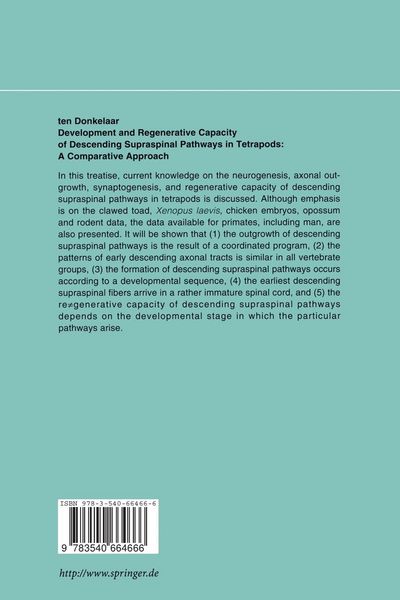
Development and Regenerative Capacity of Descending Supraspinal Pathways in Tetrapods A Comparative Approach

146,99 €

inkl. gesetzl. MwSt., Versandkostenfrei


Beschreibung

Produktdetails

Einband

Taschenbuch

Erscheinungsdatum

22.12.1999

Abbildungen

X, 145 p. 40 illus.

Verlag

Springer Berlin

Seitenzahl

145

Maße (L/B/H)

23,5/15,5/0,9 cm

Gewicht

248 g

Auflage

2000

Sprache

Englisch

ISBN

978-3-540-66466-6

Beschreibung

Produktdetails

Einband

Taschenbuch

Erscheinungsdatum

22.12.1999

Abbildungen

X, 145 p. 40 illus.

Verlag

Springer Berlin

Seitenzahl

145

Maße (L/B/H)

23,5/15,5/0,9 cm

Gewicht

248 g

Auflage

2000

Sprache

Englisch

ISBN

978-3-540-66466-6

Herstelleradresse

Springer-Verlag KG
Sachsenplatz 4-6
1201 Wien
AT

Email: ProductSafety@springernature.com

Noch keine Bewertungen vorhanden

Verfassen Sie die erste Bewertung zu diesem Artikel

Helfen Sie anderen Kundinnen und Kunden durch Ihre Meinung.

Kundinnen und Kunden meinen

Bewertungen (0)

  • Produktbild: Development and Regenerative Capacity of Descending Supraspinal Pathways in Tetrapods
  • Produktbild: Development and Regenerative Capacity of Descending Supraspinal Pathways in Tetrapods
  • 1 Introduction.- 1.1 Phylogenetic Constancy of Descending Supraspinal Pathways.- 1.2 Attractive Animal Models for Studies on the Development of Motor Systems.- 1.3 Axonal Pathfinding.- 1.4 Regenerative Capacity of Descending Supraspinal Pathways.- 1.5 Scope of the Present Review.- 2 Materials and Techniques.- 2.1 Cytoarchitectonic Analysis.- 2.2 Immunohistochemical Procedures.- 2.3 Tract-Tracing Studies.- 2.4 [3H]-Thymidine Studies.- 3 Descending Pathways to the Spinal Cord in Tetrapods: A Brief Outline.- 4 Staging Systems.- 4.1 Systems for Staging Amphibian Embryos.- 4.2 Staging Chicken Embryos.- 4.3 Systems for Staging the Prenatal and Postnatal Development of Opossums.- 4.4 Systems for Staging Rodent and Primate Embryos.- 5 Development of Descending Supraspinal Pathways in Amphibians.- 5.1 Development and Regenerative Capacity of the Motor System in Urodeles.- 5.2 Development of Anurans: Two Motor Systems.- 5.3 Neurogenesis of Brainstem Motor Nuclei: Birthday Data in Xenopus laevis.- 5.4 Tract-Tracing Data in Anurans.- 6 Development of Descending Supraspinal Pathways in Birds.- 6.1 Some Notes on the Development of the Avian Brain Stem and Spinal Cord.- 6.2 Birthday Studies in Chickens.- 6.3 Tract-Tracing Data in the Chicken Embryo.- 7 Development of Descending Supraspinal Pathways In Opossums.- 7.1 Some Notes on the Development of the CNS in Opossums.- 7.2 Birthday Studies.- 7.3 Tract-Tracing Data in Opossums.- 8 Development of Descending Supraspinal Pathways in Placental Animals.- 8.1 Initial Tract Formation.- 8.2 Tract-Tracing Data in Rodents.- 8.3 Tract-Tracing Data in Cats.- 8.4 Tract-Tracing Data in Primates.- 9 Development of Descending Supraspinal Pathways in Man.- 9.1 Some Notes on the Development of the Human Spinal Cord.- 9.2 Development of Descending Brainstem Pathways in Man.- 9.3 Development of Corticospinal Projections in Man.- 10 Concluding Remarks.- 10.1 The Outgrowth of Descending Supraspinal Pathways Is the Result of a Coordinated Program.- 10.2 The Pattern of Early Descending Axonal Tracts Is Similar in All Vertebrate Groups.- 10.3 The Formation of Descending Supraspinal Pathways Occurs According to a Developmental Sequence.- 10.4 The Earliest Descending Supraspinal Fibers Arrive in a Rather Immature Spinal Cord.- 10.5 The Regenerative Capacity of Descending Supraspinal Pathways Depends on Their Developmental Stage.- 11 Summary.- References.