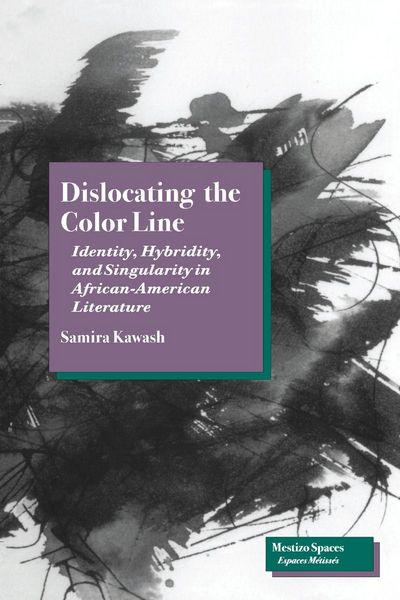
Dislocating the Color Line Identity, Hybridity, and Singularity in African-American Narrative
-
- Hardcover
- Taschenbuch ausgewählt
-
Sprache:Englisch
26,99 €
inkl. gesetzl. MwSt.,
Beschreibung
Produktdetails
Einband
Taschenbuch
Erscheinungsdatum
01.06.1997
Verlag
Stanford University PressSeitenzahl
280
Maße (L/B/H)
22,9/15,3/1,6 cm
Gewicht
386 g
Sprache
Englisch
ISBN
978-0-8047-2775-4
Inquiries into the meaning and force of race in American culture have largely focused on questions of identity and difference-What does it mean to have a racial identity? What constitutes racial difference? Such questions assume the basic principle of racial division, which todays seems to be becoming an increasingly bitter and seemingly irreparable chasm between black and white.
This book confronts this contemporary problem by shifting the focus of analysis from understanding differences to analyzing division. It provides a historical context for the recent resurgence of racial division by tracing the path of the color line as it appears in the narrative writings of African-Americans in the nineteenth and twentieth centuries. In readings of slave narratives, "passing novels," and the writings of Charles Chesnutt and Zora Neale Hurston, the author asks: What is the work of division? How does division work?
The history of the color line in the United States is coeval with that of the nation. The author suggests that throughout this history, the color line has not functioned simply to name biological or cultural difference, but more important, it has served as a principle of division, classification, and order. In this way, the color line marks the inseparability of knowledge and power in a racially demarcated society. The author shows how, from the time of slavery to today, the color line has figured as the locus of such central tenets of American political life as citizenship, subjectivity, community, law, freedom, and justice.
This book seeks not only to understand, but also to bring critical pressure on the interpretations, practices, and assumptions that correspond to and buttress representations of racial difference. The work of dislocating the color line lies in uncovering the uncertainty, the incoherency, and the discontinuity that the common sense of the color line masks, while at the same time elucidating the pressures that transform the contingent relations of the color line into common sense.
Noch keine Bewertungen vorhanden
Verfassen Sie die erste Bewertung zu diesem Artikel
Helfen Sie anderen Kundinnen und Kunden durch Ihre Meinung.
Kurze Frage zu unserer Seite
Vielen Dank für dein Feedback
Wir nutzen dein Feedback, um unsere Produktseiten zu verbessern. Bitte habe Verständnis, dass wir dir keine Rückmeldung geben können. Falls du Kontakt mit uns aufnehmen möchtest, kannst du dich aber gerne an unseren Kund*innenservice wenden.
zum Kundenservice