KI-Beratung Beta

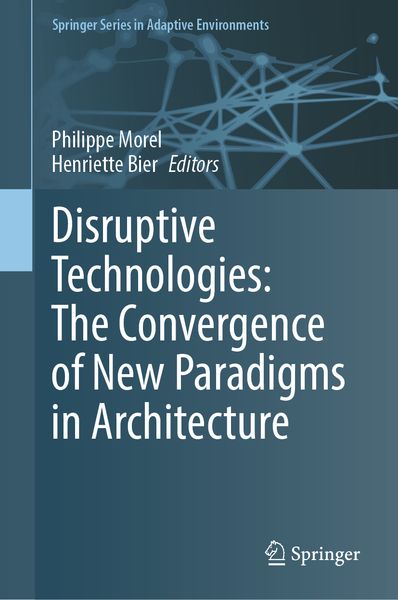
Produktbild: Disruptive Technologies: The Convergence of New Paradigms in Architecture
- 13%

Disruptive Technologies: The Convergence of New Paradigms in Architecture

13% sparen

157,99 € UVP 181,89 €

inkl. gesetzl. MwSt., Versandkostenfrei


Beschreibung

Produktdetails

Einband

Gebundene Ausgabe

Erscheinungsdatum

03.05.2023

Abbildungen

XVIII, 197 p. 63 illus., 48 illus. in color.

Herausgeber

Philippe Morel + weitere

Verlag

Springer

Seitenzahl

197

Maße (L/B/H)

24,1/16/1,8 cm

Gewicht

494 g

Auflage

2023

Sprache

Englisch

ISBN

978-3-031-14159-1

Beschreibung

Portrait


Philippe Morel is an architect, theorist and entrepreneur, co-founder of EZCT Architecture & Design Research (2000) and initiator and founding CEO of the large-scale 3D-printing corporation XtreeE (2015). He currently teaches as an Associate Professor at the École nationale supérieure d'architecture Paris-Malaquais, where he headed the Digital Knowledge department (co-founded with Pr. Girard), and at UCL Bartlett where he held a Visiting Professorship position. Before teaching at the Bartlett, he was a seminar and studio Professor at the Berlage Institute in Rotterdam, and a history and theory seminar and AADRL tutor at the Architectural Association in London. In 2017, he co-edited the book Computational politics and architecture: From Digital Philosophy to the End of Work (Editions ENSAPM). In February 2007, he curated the exhibition Architecture Beyond Forms: The Computational Turn at the Maison de l’architecture et de la ville PACA in Marseille. Explicitly departing from Eisenman PhD’s dissertation from 1963 – The Formal Basis of Modern Architecture –, the exhibition addressed both historically and theoretically the current linguistic and computational turns in architectural design. Philippe Morel has published more than 30 essays, lectured in many universities around the world and presented his work in numerous exhibitions. His work and the one of his office are part of private and public collections, including FRAC Centre and Centre Pompidou permanent collections.

Henriette H. Bier, after graduating in architecture (1998) from the University of Karlsruhe in Germany, has worked with Morphosis (1999-01) on internationally relevant projects in the US and Europe. She has taught computational design (2002-03) at universities in Austria, Germany, Belgium and the Netherlands and since 2004 she mainly teaches and researches at Technical University Delft (TUD) with focus on robotics in architecture. She initiated and coordinated (2005-06) the workshop and lecture series on Digital Design and Fabrication with invited guests from MIT and ETHZ and finalized (2008) her PhD on System-embedded Intelligence in Architecture. She coordinated EU-funded projects E-Archidoct and F2F Continuum (2007-10), led NL-funded projects Scalable Porosity and Adaptive Stiffness (2015-18), and ESA-funded project Rhizome (2021-22). 2017-19, she has been appointed professor at Dessau Institute of Architecture and 2020 visiting researcher at PoliMi. Results of her research are published in books, journals and conference proceedings and she regularly lectures and leads workshops internationally.


Produktdetails

Einband

Gebundene Ausgabe

Erscheinungsdatum

03.05.2023

Abbildungen

XVIII, 197 p. 63 illus., 48 illus. in color.

Herausgeber

Verlag

Springer

Seitenzahl

197

Maße (L/B/H)

24,1/16/1,8 cm

Gewicht

494 g

Auflage

2023

Sprache

Englisch

ISBN

978-3-031-14159-1

Herstelleradresse

Springer-Verlag KG
Sachsenplatz 4-6
1201 Wien
AT

Email: ProductSafety@springernature.com

Noch keine Bewertungen vorhanden

Verfassen Sie die erste Bewertung zu diesem Artikel

Helfen Sie anderen Kundinnen und Kunden durch Ihre Meinung.

Kundinnen und Kunden meinen

Bewertungen (0)

  • Produktbild: Disruptive Technologies: The Convergence of New Paradigms in Architecture

  • 1: Disruptive Technologies in Architecture (General Introduction).- 2.1: Robotics and AI in Architecture.- 2.2: Bioptemes and Mechy Max Systems: Topological Imaginations of Adaptive Architecture.- 2.3: How Do We Want to Interact with Robotic Environments? User Preferences for Embodied Interactions, from Pushbuttons to AI.- 2.4: Design-to-Robotic-Production and -Operation for Activating Bio-Cyber-Physical Environments.- 2.5: Conceptual and Methodological Constructs for People-Oriented Public Spaces.- 3.1: Architectural Intelligence, Machine and Human Learning.- 3.2: Architectural Knowledge and Learning Algorithms.- 3.3: On Legibility: Machine Readable Architecture.- 3.4: Where is reality? Can you show it to me? Constructing Artificial Agency.- 3.6: From Disruptions in Architectural Pedagogy to Disruptive Pedagogies for Architecture.- 4.1: Cyber-Urban Integration, Disruptive Construction Technologies, and Tectonics.- 4.2: Cyber-Urban Integration.- 4.3: Democratising Tectonism: High performance geometry for mass-customisation of virtual and physical spaces.- 4.4: Why Disruptive Business Models are Inseparable from Disruptive Technologies?.