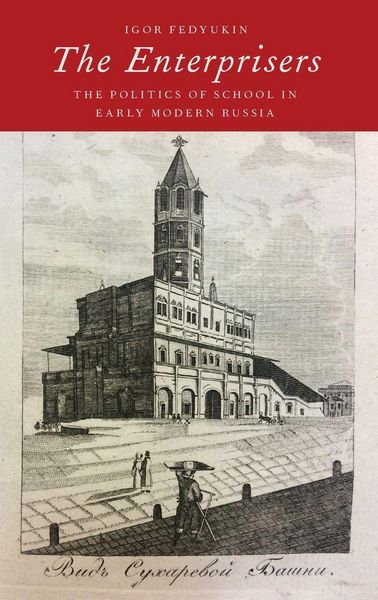
Enterprisers The Politics of School in Early Modern Russia
119,99 €
inkl. gesetzl. MwSt.,
Beschreibung
Produktdetails
Einband
Gebundene Ausgabe
Erscheinungsdatum
29.05.2019
Abbildungen
12
Verlag
Oxford AcademicSeitenzahl
330
Maße (L/B/H)
24/16,1/2,2 cm
Gewicht
661 g
Sprache
Englisch
ISBN
978-0-19-084500-1
The Enterprisers traces the emergence of the "modern" school in Russia during the reigns of Peter I and his immediate successors, up to the accession of Catherine II. Creation of the new, secular, technically-oriented schools based on the imported Western European blueprints is traditionally presented as the key element in Peter I's transformation of Russia. The tsar, it is assumed, needed schools to train officers and engineers for his new army and the navy, and so he personally designed these new institutions and forced them upon his unwilling subjects. In this sense, school also stands in as a metaphor for modern institutions in Russia in general, which are likewise seen as created from the top down, by the forceful state, in response to its military and technological needs. Yet, in reality, Peter I himself never wrote much about education, and while he championed "learning" in a broad sense, he had remarkably little to say about the ways schools and schooling should be organized. Nor were his general and admirals, including foreigners in Russian service, keen on promoting formal schooling: for them, practical apprenticeship still remained the preferred method of training. Rather, as Fedyukin argues in this book, the trajectories of institutional change were determined by the efforts of "administrative entrepreneurs"-or projecteurs, as they were also called-who built new schools as they sought to achieve diverse career goals, promoted their own pet ideas, advanced their claims for expertise, and competed for status and resources. By drawing on a wealth of unpublished archival sources, Fedyukin explores the "micropolitics" behind the key episodes of educational innovation in the first half of the eighteenth century and offers an entirely new way of thinking about "Petrine revolution" and about the early modern state in Russia.
Noch keine Bewertungen vorhanden
Verfassen Sie die erste Bewertung zu diesem Artikel
Helfen Sie anderen Kundinnen und Kunden durch Ihre Meinung.
Kurze Frage zu unserer Seite
Vielen Dank für dein Feedback
Wir nutzen dein Feedback, um unsere Produktseiten zu verbessern. Bitte habe Verständnis, dass wir dir keine Rückmeldung geben können. Falls du Kontakt mit uns aufnehmen möchtest, kannst du dich aber gerne an unseren Kund*innenservice wenden.
zum Kundenservice