
Equitable Access to Human Biological Resources in Developing Countries Benefit Sharing Without Undue Inducement
-
- Hardcover ausgewählt
- Taschenbuch
- eBook
-
Sprache:Englisch
97,99 €
inkl. gesetzl. MwSt.,
Beschreibung
Produktdetails
Einband
Gebundene Ausgabe
Erscheinungsdatum
27.07.2015
Abbildungen
XIX, 197 p.
Verlag
SpringerSeitenzahl
197
Maße (L/B/H)
24,1/16/1,8 cm
Gewicht
500 g
Auflage
1st ed. 2016
Sprache
Englisch
ISBN
978-3-319-19724-1
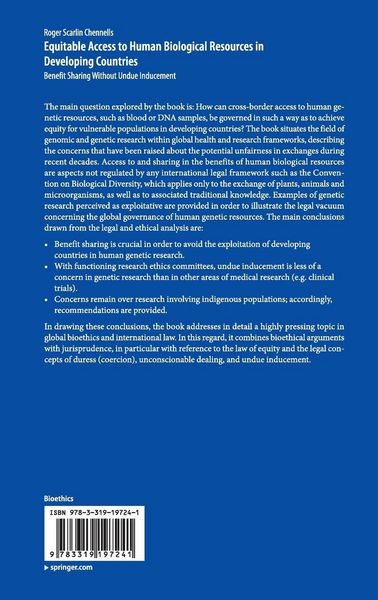
The main question explored by the book is: How can cross-border access to human genetic resources, such as blood or DNA samples, be governed in such a way as to achieve equity for vulnerable populations in developing countries? The book situates the field of genomic and genetic research within global health and research frameworks, describing the concerns that have been raised about the potential unfairness in exchanges during recent decades. Access to and sharing in the benefits of human biological resources are aspects not regulated by any international legal framework such as the Convention on Biological Diversity, which applies only to the exchange of plants, animals and microorganisms, as well as to associated traditional knowledge. Examples of genetic research perceived as exploitative are provided in order to illustrate the legal vacuum concerning the global governance of human genetic resources. The main conclusions drawn from the legal and ethical analysis are:
• Benefit sharing is crucial in order to avoid the exploitation of developing countries in human genetic research.
• With functioning research ethics committees, undue inducement is less of a concern in genetic research than in other areas of medical research (e.g. clinical trials).
• Concerns remain over research involving indigenous populations; accordingly, recommendations are provided.
In drawing these conclusions, the book addresses in detail a highly pressing topic in global bioethics and international law. In this regard, it combines bioethical arguments with jurisprudence, in particular with reference to thelaw of equity and the legal concepts of duress (coercion), unconscionable dealing, and undue inducement.
Noch keine Bewertungen vorhanden
Verfassen Sie die erste Bewertung zu diesem Artikel
Helfen Sie anderen Kundinnen und Kunden durch Ihre Meinung.
Kurze Frage zu unserer Seite
Vielen Dank für dein Feedback
Wir nutzen dein Feedback, um unsere Produktseiten zu verbessern. Bitte habe Verständnis, dass wir dir keine Rückmeldung geben können. Falls du Kontakt mit uns aufnehmen möchtest, kannst du dich aber gerne an unseren Kund*innenservice wenden.
zum Kundenservice