• Produktbild: Essays on Logic and its Applications in Philosophy
  • Produktbild: Essays on Logic and its Applications in Philosophy
Band 3

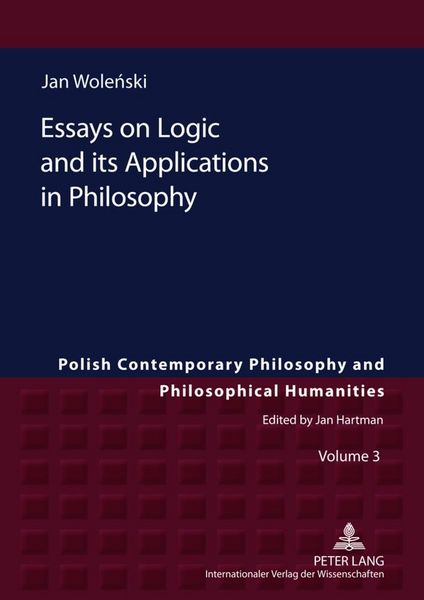
Essays on Logic and its Applications in Philosophy

88,75 €

inkl. gesetzl. MwSt., Versandkostenfrei


Beschreibung

Produktdetails

Einband

Gebundene Ausgabe

Erscheinungsdatum

10.10.2011

Verlag

Peter Lang GmbH, Internationaler Verlag der Wissenschaften

Seitenzahl

364

Maße (L/B/H)

21,6/15,3/2,3 cm

Gewicht

580 g

Auflage

1

Sprache

Englisch

ISBN

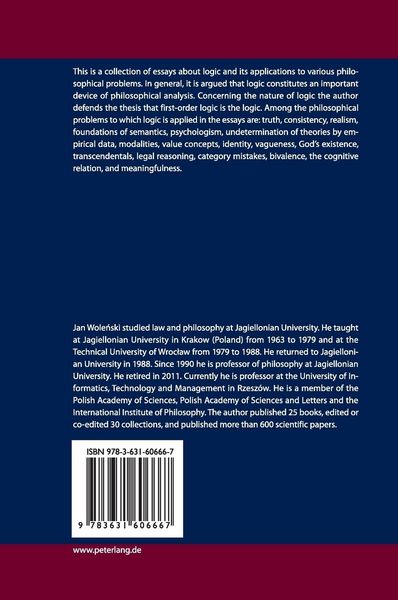
978-3-631-60666-7

Beschreibung

Produktdetails

Einband

Gebundene Ausgabe

Erscheinungsdatum

10.10.2011

Verlag

Peter Lang GmbH, Internationaler Verlag der Wissenschaften

Seitenzahl

364

Maße (L/B/H)

21,6/15,3/2,3 cm

Gewicht

580 g

Auflage

1

Sprache

Englisch

ISBN

978-3-631-60666-7

EU-Ansprechpartner

Kolibri 360 GmbH
Ettore-Bugatti-Straße 6-14
51149 Köln
DE
produktsicherheit@kolibri360.de

Herstelleradresse

Peter Lang
Avenue du Théâtre 7
1005 Lausanne
CH
orders@peterlang.com

Noch keine Bewertungen vorhanden

Verfassen Sie die erste Bewertung zu diesem Artikel

Helfen Sie anderen Kundinnen und Kunden durch Ihre Meinung.

Kundinnen und Kunden meinen

Bewertungen (0)

  • Produktbild: Essays on Logic and its Applications in Philosophy
  • Produktbild: Essays on Logic and its Applications in Philosophy
  • Contents: Logic, Rhetoric and Hermeneutic in Philosophy – Truth and Satisfaction by the Empty Sequence – Metalogical Observations about Undetermination of Theories by Empirical Data – Psychologism and Metalogic – Malum, Transcendentalia and Logic – Logic, Semantics, and Realism – First-Order Logic: (Philosophical) Pro and Contra – What is Formal in Formal Semantics? – On Some Formal Properties of Truth – Gödel, Tarski and Truth – Is Truth an Ontological Concept? – What are Truth-Bearers? – A Generalization of Hume’s Thesis – Tarskian and Post-Tarskian Truth – Two Critical Contributions to the Problem of Truth and Meaning – On So-Called Sentences with Category Mistakes – The Cognitive Relation in a Formal Setting – Models of Legal Reasoning – The Character of T-Equivalences – Remarks on Identity across Possible Worlds – Applications of Squares of Oppositions and Their Generalizations – Theism, Fideism, Atheism, Agnosticism – The Principle of Bivalence and Suszko – Vagueness and Ambiguity – Truth and Consistency – Meaningfulness, Meaninglessness and Language-Hierarchies – Some Lessons from Ingarden’s Criticism of the Verifiability Principle – Remarks on Axiomatization within Logic.