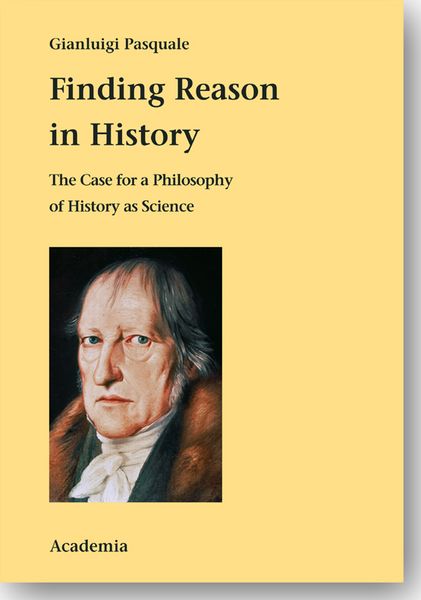
Finding Reason in History The Case for a Philosophy of History as Science
-
- Englisch ausgewählt
32,50 €
inkl. gesetzl. MwSt.,
Beschreibung
Produktdetails
Einband
Gebundene Ausgabe
Erscheinungsdatum
01.06.2014
Verlag
AcademiaSeitenzahl
298
Maße (B/H)
14,8/21 cm
Gewicht
542 g
Auflage
1
Übersetzt von
Francesca Ferrando
Sprache
Englisch
ISBN
978-3-89665-619-3
History follows a tortuous, at times unfathomable path. Yet there are those who discern a sense, a unifying drive, even, in that intricate tangle of events. They believe a powerful rationality acts within history, which needs to be understood through a seamless conceptual structure. Thus, a science of history becomes possible. Among those who hold this view, some see an immanent principle in the development of events, others see therein God's transcendence. This essay opens up with a radical question: is it possible to find in history the reason that will allow me to be saved? The author's argumentation hinges on a comparative analysis of Georg Wilhelm Friedrich Hegel, who theorized the Absolute as a dialectical, historical process, and one of his great contemporary interpreters, Wolfhart Pannenberg. According both to Hegel's dialectic and Pannenberg's Christological thought, history does not unfold from the past toward the future, but runs from the future toward the past, so that truth in history may only be reconstructed retrospectively, in the totality of what occurs.
The study is divided into three main chapters, preceded by an ample introduction and followed by a set of conclusions. In the introduction, Pasquale outlines the concept of history in Hegel and Pannenberg, emphasizing common traits and dwelling in particular upon certain
figures
of Hegel's system - such as 'devotion' and 'unhappy consciousness' - which have been reinterpreted theologically by Pannenberg. The first chapter focuses on the historical-eschatological dialectic of the Christian event, giving a detailed presentation of Pannenberg's position, particularly of its Christological implications. The second chapter analyzes Pannenberg's theme of the 'anticipation of the end', examining it in relation to the logical structure of Hegel's dialectic. The third chapter deals with the delicate relationship between the contingency of historical events - which appear as fragmented, incomplete reality - and the definitive sense given them by the perspective of
totality
, as expected at the end of the historical process. The conclusions offer interesting applications of the dialectics of anticipation and back-projection of the end of history in ontology and metaphysics, with particular emphasis on the relation between becoming and essence and between finiteness and transcendence.
'Throughout his informative book, P. shows how, paradoxically, Pannenberg sets out to use Hegel's philosophy against Hegel, in order to gain a deeper understanding of some fundamental elements of a 'classic' Christian view'
Theological Studies 74 (2)
Noch keine Bewertungen vorhanden
Verfassen Sie die erste Bewertung zu diesem Artikel
Helfen Sie anderen Kundinnen und Kunden durch Ihre Meinung.
Kurze Frage zu unserer Seite
Vielen Dank für dein Feedback
Wir nutzen dein Feedback, um unsere Produktseiten zu verbessern. Bitte habe Verständnis, dass wir dir keine Rückmeldung geben können. Falls du Kontakt mit uns aufnehmen möchtest, kannst du dich aber gerne an unseren Kund*innenservice wenden.
zum Kundenservice