Gutscheinbedingungen

**Gültig bis 10.06.2026 / Gültig für gebrauchte Bücher / Mindestbestellwert 20,00 € / Einzelne Artikel können ausgeschlossen sein / Online auf www.bücher.de.de / Nicht kombinierbar mit anderen Gutscheinen oder Preisaktionen / Nur einmal pro Einkauf einlösbar / Gutschein wird auf max. 500€ Bestellwert angerechnet / Keine Barauszahlung / Nicht gültig für Versandkosten und Services

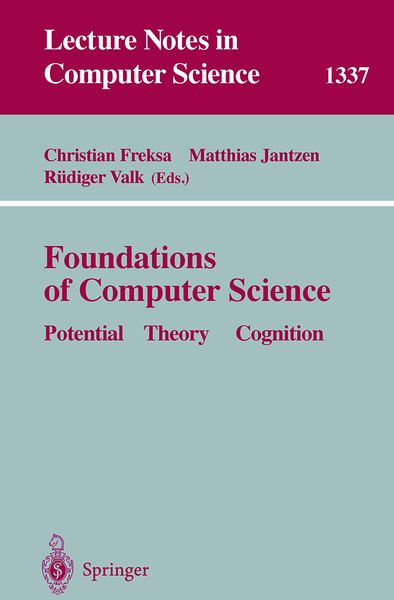
  • Produktbild: Foundations of Computer Science
  • Produktbild: Foundations of Computer Science
Band 1337

Foundations of Computer Science Potential-Theory-Cognition

97,99 €

inkl. gesetzl. MwSt., Versandkostenfrei

Lieferung nach Hause

Beschreibung

Produktdetails

Einband

Taschenbuch

Erscheinungsdatum

24.10.1997

Herausgeber

Christian Freksa + weitere

Verlag

Springer Berlin

Seitenzahl

524

Maße (L/B/H)

23,5/15,5/2,8 cm

Gewicht

803 g

Auflage

1997

Sprache

Englisch

ISBN

978-3-540-63746-2

Beschreibung

Produktdetails

Einband

Taschenbuch

Erscheinungsdatum

24.10.1997

Herausgeber

Verlag

Springer Berlin

Seitenzahl

524

Maße (L/B/H)

23,5/15,5/2,8 cm

Gewicht

803 g

Auflage

1997

Sprache

Englisch

ISBN

978-3-540-63746-2

Herstelleradresse

Springer-Verlag KG
Sachsenplatz 4-6
1201 Wien
AT

Email: [email protected]

Kundinnen und Kunden meinen

0 Bewertungen

Informationen zu Bewertungen

Zur Abgabe einer Bewertung ist eine Anmeldung im Konto notwendig. Die Authentizität der Bewertungen wird von uns nicht überprüft. Wir behalten uns vor, Bewertungstexte, die unseren Richtlinien widersprechen, entsprechend zu kürzen oder zu löschen.

Die Bewertungen sind nach Format, Anzahl Sterne und Datum sortiert.

Verfassen Sie die erste Bewertung zu diesem Artikel

Helfen Sie anderen Kund*innen durch Ihre Meinung

Kundinnen und Kunden meinen

0 Bewertungen filtern

  • Produktbild: Foundations of Computer Science
  • Produktbild: Foundations of Computer Science
  • The might of formulas and their limits.- Hardware — Software.- Defining discipline.- Computer science as cultural development.- Towards adjusting informatics education to information era.- Informatics and society: A curriculum for distance education.- Syntactic and semantic aspects of parallelism.- Unique fixpoints in complete lattices with applications to formal languages and semantics.- On abstract families of languages, power series, and elements.- Are there formal languages complete for SymSPACE(log n)?.- On twist-closed trios: A new morphic characterization of r.e. sets.- An automata approach to some problems on context-free grammars.- On aperiodic sets of Wang tiles.- Closure under complementation of logspace complexity classes - A survey -.- A relation between sparse and printable sets in NSPACE(log n).- A foundation for computable analysis.- A computer scientist's view of life, the universe, and everything.- Calendars and chronologies.- A uniform approach to Petri Nets.- Observing partial order runs of Petri Nets.- Representation theorems for Petri Nets.- A remark on trace equations.- Verification of distributed algorithms with algebraic Petri Nets.- A short story on action refinement.- Interactive and reactive systems: States, observations, experiments, input, output, nondeterminism, compositionality and all that.- Discrete time analysis of a state dependent tandem with different customer types.- How distributed algorithms play the token game.- The asynchronous stack revisited: Rounds set the twilight reeling.- Online scheduling of continuous media streams.- Contribution to Goodenough's and Gerhart's theory of software testing and verification: Relation between strong compiler test and compiler implementation verification.- On the arrangement complexity of uniform trees.- A relational-functional integration for declarative programming.- Inside and outside the Chinese room.- Abstract structures in spatial cognition.- Spatial and temporal structures in cognitive processes.- Qualitative vs. Fuzzy representations of spatial distance.- What's a part? On formalizing part-whole relations.- SPOCK: A feasibility study on the completeness of parts lists.- Decision support systems with adaptive reasoning strategies.- Knowledge discovery in databases — An inductive logic programming approach.- The composition heuristic.- The job assignment problem: A study in parallel and distributed machine learning.- Self-improving behavior arbitration.- Neural networks for manipulator path planning.- Path planning using a subgoal graph.- A nonlinear markovian characterization of time series using neural networks.- Feature-based perception of semantic concepts.- Automatic detection of thesaurus relations for information retrieval applications.- InfoSphere ? -V: a new approach to 3D-visualization of information.