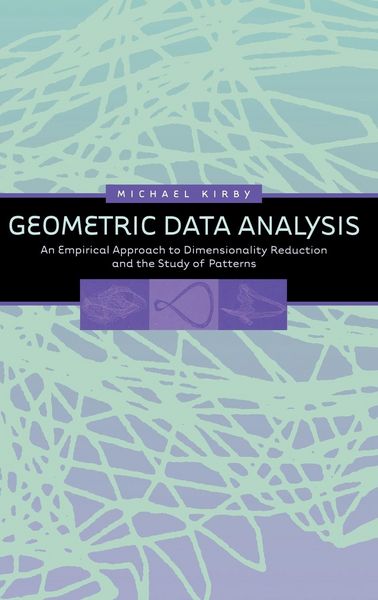
Geometric Data Analysis An Empirical Approach to Dimensionality Reduction and the Study of Patterns
-
- Englisch ausgewählt
171,99 €
inkl. gesetzl. MwSt.,
Beschreibung
Produktdetails
Einband
Gebundene Ausgabe
Erscheinungsdatum
29.12.2000
Abbildungen
w. figs.
Verlag
John Wiley & Sons IncSeitenzahl
384
Maße (L/B/H)
24/16,1/2,5 cm
Gewicht
742 g
Auflage
1. Auflage
Sprache
Englisch
ISBN
978-0-471-23929-1
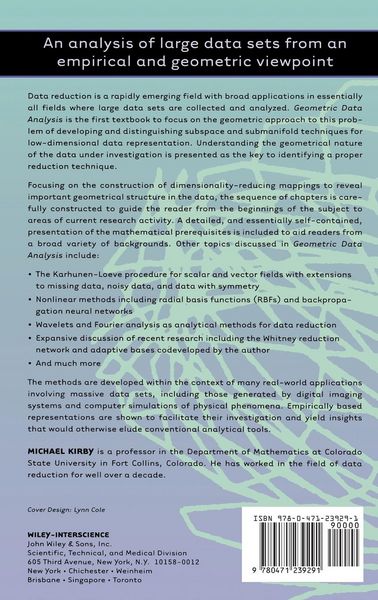
An analysis of large data sets from an empirical and geometric viewpoint
Data reduction is a rapidly emerging field with broad applications in essentially all fields where large data sets are collected and analyzed. Geometric Data Analysis is the first textbook to focus on the geometric approach to this problem of developing and distinguishing subspace and submanifold techniques for low-dimensional data representation. Understanding the geometrical nature of the data under investigation is presented as the key to identifying a proper reduction technique.
Focusing on the construction of dimensionality-reducing mappings to reveal important geometrical structure in the data, the sequence of chapters is carefully constructed to guide the reader from the beginnings of the subject to areas of current research activity. A detailed, and essentially self-contained, presentation of the mathematical prerequisites is included to aid readers from a broad variety of backgrounds. Other topics discussed in Geometric Data Analysis include:
* The Karhunen-Loeve procedure for scalar and vector fields with extensions to missing data, noisy data, and data with symmetry
* Nonlinear methods including radial basis functions (RBFs) and backpropa-gation neural networks
* Wavelets and Fourier analysis as analytical methods for data reduction
* Expansive discussion of recent research including the Whitney reduction network and adaptive bases codeveloped by the author
* And much more
The methods are developed within the context of many real-world applications involving massive data sets, including those generated by digital imaging systems and computer simulations of physical phenomena. Empirically based representations are shown to facilitate their investigation and yield insights that would otherwise elude conventional analytical tools.
Noch keine Bewertungen vorhanden
Verfassen Sie die erste Bewertung zu diesem Artikel
Helfen Sie anderen Kundinnen und Kunden durch Ihre Meinung.
Kurze Frage zu unserer Seite
Vielen Dank für dein Feedback
Wir nutzen dein Feedback, um unsere Produktseiten zu verbessern. Bitte habe Verständnis, dass wir dir keine Rückmeldung geben können. Falls du Kontakt mit uns aufnehmen möchtest, kannst du dich aber gerne an unseren Kund*innenservice wenden.
zum Kundenservice