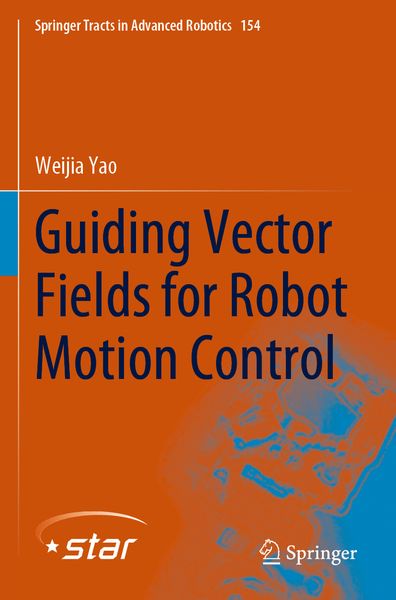
Guiding Vector Fields for Robot Motion Control
-
- Hardcover
- Taschenbuch ausgewählt
- eBook
-
Sprache:Englisch
131,99 €
UVP
149,79 €
inkl. gesetzl. MwSt.,
Beschreibung
Produktdetails
Einband
Taschenbuch
Erscheinungsdatum
27.07.2024
Abbildungen
XXX, 255 p. 57 illus., 44 illus. in color.
Verlag
SpringerSeitenzahl
255
Maße (L/B/H)
23,5/15,5/1,6 cm
Gewicht
441 g
Auflage
2023
Sprache
Englisch
ISBN
978-3-031-29154-8
Using a designed vector field to guide robots to follow a given geometric desired path has found a range of practical applications, such as underwater pipeline inspection, warehouse navigation, and highway traffic monitoring. It is thus in great need to build a rigorous theory to guide practical implementations with formal guarantees. It is even so when multiple robots are required to follow predefined desired paths or maneuver on surfaces and coordinate their motions to efficiently accomplish repetitive and laborious tasks.
The book introduces guiding vector fields on Euclidean spaces and Riemannian manifolds for single-robot and multi-robot path-following and motion coordination, provides rigorous theoretical guarantees of vector field guided motion control of robotic systems, and elaborates on the practical implementation of the proposed algorithms on mobile wheeled robots and fixed-wing aircraft. It provides guidelines for the robust, reliable, and safe practical implementations for robotic tasks, including path-following navigation, obstacle-avoidance, and multi-robot motion coordination.
In particular, the book reveals fundamental theoretic underpinnings of guiding vector fields and applies to addressing various robot motion control problems. Notably, it answers many crucial and challenging questions such as:
· How to generate a general guiding vector field on any n-dimensional Riemannian manifold for robot motion control tasks?
· Do singular points always exist in a general guiding vector field?
· How to generate a guiding vector field that is free of singular points?
· How to design control algorithms based on guiding vector fields for different robot motion control tasks including path-following, obstacle-avoidance, and multi-robot distributed motion coordination?
Answering these questions has led to the discovery of fundamental assumptions, a “topological surgery” to create a singularity-free guiding vector field, a robot navigation algorithm with the global convergence property, a provably safe collision-avoidance algorithm and an effective distributed motion control algorithm, etc
Noch keine Bewertungen vorhanden
Verfassen Sie die erste Bewertung zu diesem Artikel
Helfen Sie anderen Kundinnen und Kunden durch Ihre Meinung.
Kurze Frage zu unserer Seite
Vielen Dank für dein Feedback
Wir nutzen dein Feedback, um unsere Produktseiten zu verbessern. Bitte habe Verständnis, dass wir dir keine Rückmeldung geben können. Falls du Kontakt mit uns aufnehmen möchtest, kannst du dich aber gerne an unseren Kund*innenservice wenden.
zum Kundenservice