Beschreibung
Produktdetails
Einband
Gebundene Ausgabe
Erscheinungsdatum
02.04.2019
Abbildungen
IX, 384 p. 164 illus., 129 illus. in color.
Herausgeber
Ali Dehghantanha + weitereVerlag
SpringerSeitenzahl
384
Maße (L/B/H)
24,1/16/2,7 cm
Gewicht
758 g
Auflage
1st edition 2019
Sprache
Englisch
ISBN
978-3-030-10542-6
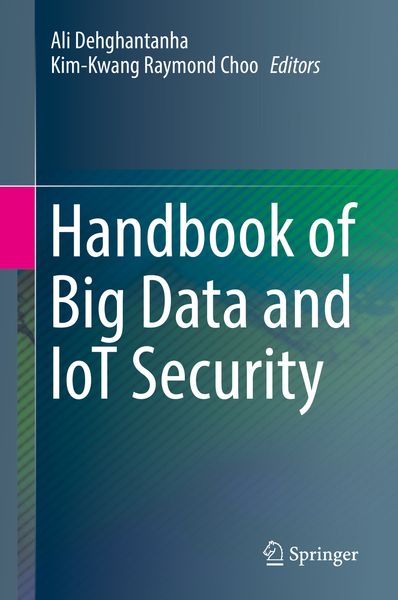
This handbook provides an overarching view of cyber security and digital forensic challenges related to big data and IoT environment, prior to reviewing existing data mining solutions and their potential application in big data context, and existing authentication and access control for IoT devices. An IoT access control scheme and an IoT forensic framework is also presented in this book, and it explains how the IoT forensic framework can be used to guide investigation of a popular cloud storage service.
A distributed file system forensic approach is also presented, which is used to guide the investigation of Ceph. Minecraft, a Massively Multiplayer Online Game, and the Hadoop distributed file system environment are also forensically studied and their findings reported in this book. A forensic IoT source camera identification algorithm is introduced, which uses the camera's sensor pattern noise from the captured image.
In addition to the IoT access control and forensic frameworks, this handbook covers a cyber defense triage process for nine advanced persistent threat (APT) groups targeting IoT infrastructure, namely: APT1, Molerats, Silent Chollima, Shell Crew, NetTraveler, ProjectSauron, CopyKittens, Volatile Cedar and Transparent Tribe.
The characteristics of remote-controlled real-world Trojans using the Cyber Kill Chain are also examined. It introduces a method to leverage different crashes discovered from two fuzzing approaches, which can be used to enhance the effectiveness of fuzzers. Cloud computing is also often associated with IoT and big data (e.g., cloud-enabled IoT systems), and hence a survey of the cloud security literature and a survey of botnet detection approaches are presented in the book. Finally, game security solutions are studied and explained how one may circumvent such solutions.
This handbook targets the security, privacy and forensics research community, and big data research community, including policy makers and government agencies, public and private organizations policy makers. Undergraduate and postgraduate students enrolled in cyber security and forensic programs will also find this handbook useful as a reference.
Noch keine Bewertungen vorhanden
Verfassen Sie die erste Bewertung zu diesem Artikel
Helfen Sie anderen Kundinnen und Kunden durch Ihre Meinung.
Kurze Frage zu unserer Seite
Vielen Dank für dein Feedback
Wir nutzen dein Feedback, um unsere Produktseiten zu verbessern. Bitte habe Verständnis, dass wir dir keine Rückmeldung geben können. Falls du Kontakt mit uns aufnehmen möchtest, kannst du dich aber gerne an unseren Kund*innenservice wenden.
zum Kundenservice