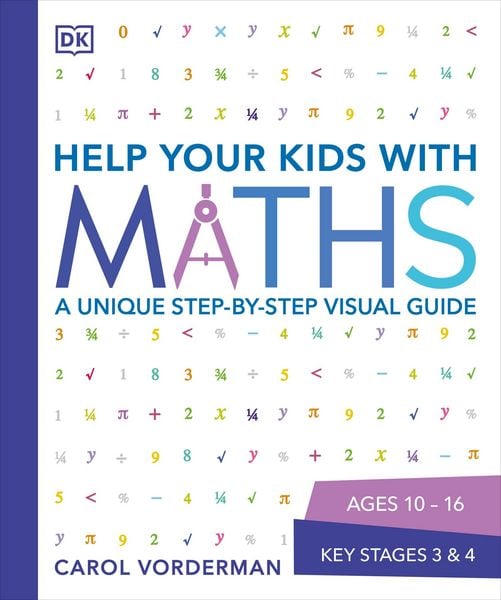
Produktbild: Help Your Kids with Maths, Ages 10-16 (Key Stages 3-4)

Help Your Kids with Maths, Ages 10-16 (Key Stages 3-4) A Unique Step-by-Step Visual Guide, Revision and Reference

Aus der Reihe DK Help Your Kids With

17,99 €

inkl. gesetzl. MwSt., Versandkostenfrei

Lieferung nach Hause

Beschreibung

Produktdetails

ISBN

978-1-4093-5571-7

Erscheinungsdatum

01.07.2014

Einband

Taschenbuch

Verlag

Dorling Kindersley UK

Seitenzahl

264

Maße (L/B/H)

23,8/19,7/2,2 cm

Gewicht

824 g

Sprache

Englisch

Beschreibung

Produktdetails

ISBN

978-1-4093-5571-7

Erscheinungsdatum

01.07.2014

Einband

Taschenbuch

Verlag

Dorling Kindersley UK

Seitenzahl

264

Maße (L/B/H)

23,8/19,7/2,2 cm

Gewicht

824 g

Sprache

Englisch

Herstelleradresse

Libri GmbH
Europaallee 1
36244 Bad Hersfeld
DE

Email: gpsr@libri.de

Kundinnen und Kunden meinen

0 Bewertungen

Informationen zu Bewertungen

Zur Abgabe einer Bewertung ist eine Anmeldung im Konto notwendig. Die Authentizität der Bewertungen wird von uns nicht überprüft. Wir behalten uns vor, Bewertungstexte, die unseren Richtlinien widersprechen, entsprechend zu kürzen oder zu löschen.

Die Bewertungen sind nach Format, Anzahl Sterne und Datum sortiert.

Verfassen Sie die erste Bewertung zu diesem Artikel

Helfen Sie anderen Kund*innen durch Ihre Meinung

Kundinnen und Kunden meinen

0 Bewertungen filtern

  • Produktbild: Help Your Kids with Maths, Ages 10-16 (Key Stages 3-4)

    • 1: Foreword

    • 2: Introduction

    • 3: Numbers


      • 1: Introducing numbers

      • 2: Addition

      • 3: Subtraction

      • 4: Multiplication

      • 5: Division

      • 6: Prime numbers

      • 7: Units of measurement

      • 8: Telling the time

      • 9: Roman numerals

      • 10: Positive and negative numbers

      • 11: Powers and roots

      • 12: Surds

      • 13: Standard form

      • 14: Decimals

      • 15: Binary numbers

      • 16: Fractions

      • 17: Ratio and proportion

      • 18: Percentages

      • 19: Converting fractions, decimals, and percentages

      • 20: Mental maths

      • 21: Rounding off

      • 22: Using a calculator

      • 23: Personal finance

      • 24: Business finance


    • 4: Geometry


      • 1: What is geometry?

      • 2: Tools in geometry

      • 3: Angles

      • 4: Straight lines

      • 5: Symmetry

      • 6: Coordinates

      • 7: Vectors

      • 8: Translations

      • 9: Rotations

      • 10: Reflections

      • 11: Enlargements

      • 12: Scale drawings

      • 13: Bearings

      • 14: Constructions

      • 15: Loci

      • 16: Triangles

      • 17: Constructing triangles

      • 18: Congruent triangles

      • 19: Area of a triangle

      • 20: Similar triangles

      • 21: Pythagoras' theorem

      • 22: Quadrilaterals

      • 23: Polygons

      • 24: Circles

      • 25: Circumference and diameter

      • 26: Area of a circle

      • 27: Angles in a circle

      • 28: Chords and cyclic quadrilaterals

      • 29: Tangents

      • 30: Arcs

      • 31: Sectors

      • 32: Solids

      • 33: Volumes

      • 34: Surface area of solids


    • 5: Trigonometry


      • 1: What is trigonometry?

      • 2: Using formulas in trigonometry

      • 3: Finding missing sides

      • 4: Finding missing angles


    • 6: Algebra


      • 1: What is algebra?

      • 2: Sequences

      • 3: Working with expressions

      • 4: Expanding and factorizing expressions

      • 5: Quadratic expressions

      • 6: Formulas

      • 7: Solving equations

      • 8: Linear graphs

      • 9: Simultaneous equations

      • 10: Factorizing quadratic equations

      • 11: The quadratic formula

      • 12: Quadratic graphs

      • 13: Inequalities


    • 7: Statistics


      • 1: What is statistics?

      • 2: Collecting and organizing data

      • 3: Bar charts

      • 4: Pie charts

      • 5: Line graphs

      • 6: Averages

      • 7: Moving averages

      • 8: Measuring spread

      • 9: Histograms

      • 10: Scatter diagrams


    • 8: Probability


      • 1: What is probability?

      • 2: Expectation and reality

      • 3: Combined probabilities

      • 4: Dependent events

      • 5: Tree diagrams


    • 9: Reference section

    • 10: Glossary

    • 11: Index

    • 12: Acknowledgements